Showing posts with label EMMA. Show all posts

Monday, 19 October 2015

Gothic Art in Spotlight: biblical irony or devotion?

I had once again grand plans to make a new Creepy Reads Review but the truth is I have not had any chance to read anything else but things related to my studies. I've been feeling very stressed for the past few weeks and it has manifested in many ways, one being that I have not had the energy to read or read and comment other blogs. I believe this abstinence of blogger contact makes me more melancholic and passive, so I do try to get back into blog sphere!The best way, I hope, is to write a post.

I managed to have a short break of my overwhelming studies and went to the Espoo Museum of Modern Art aka EMMA. It is situated in the facilities of Weegee exhibition center with four other museums and one futuristic cabin that looks like a flying saucer. The exhibition center is about 20 minutes bus drive from the centrum of Helsinki, so it is a great place to visit if you are on a weekend trip in the capital of Finland.

There were many a beautiful and intriguing art works to see but here is the one that I thought was the most suitable for Gothic Art in Spotlight.

This work is made by a Finnish artist Pauno Pohjolainen 2009. It is mixed media on wood and the name of it is Court Jester. I had seen Pohjolainen's works previously but they were more abstract. From this photo you can see how 3D this artwork is. Pohjolainen's works are often quite massive and are somewhere between paintings and sculptures.

Year 2011 he has made two public works to the Cathedral of Turku. They represent the Last Supper and can be found from the artist's webpage. The webpage is unfortunately in Finnish but just scroll to the year 2011, it is easy to spot which artworks have biblical reference in them. :)

I actually find this really interesting, because the Court Jester has clear biblical allusion in it but it is not necessarily positive or without critic or irony. At least I see a lot of resemblance between the crown of thorns and this hovering circle above the skull.

I see a clear point of contact between the Savior of Christian mythology and this skull with thorns. The skull, not being human, is against Christian mythology that very clearly separates humans from animals and places man above other creatures. On the other hand, the sacrificial lamb is a powerful symbol in the Christian mythology and the face of this creature does resemble a lamb a bit.

The name of this artwork also highlight a power structure, even though it is not strictly biblical. A court jester was an anomaly, a person in a court that supposedly had no power and was ridiculous but had the possibility to bring visible other people's schemes for power. The skull is grinning a wide fool's smile with its teeth partly scattered outside its mouth. The horns are also rich of significance: the other one is broken, why? Do they resemble a Fool's Hat or more likely the biblical Devil?

I like Court Jester because it is open to various interpretations. What do you think of it?

Thursday, 14 August 2014

Gothic Art in Spotlight: Ismo Kajander's peculiar object collages

I visited EMMA (Espoo Museum of Modern Art) and here are my favorites of their permanent collection. For those who do not know, Espoo is the second biggest city in Finland and it is part of the "metropolis area", which includes the capital Helsinki and the two cities Espoo and Vantaa.

All three pieces of art are by Ismo Kajander, who was born the year the Second World War started. In the sixties Kajander travelled to Paris and he was influenced by the artistic movement le Nouveau Réalisme and started to make object collages. He has also made art with photography, he has won several prizes with his work and he has been a teacher at Aalto University School of Art, Design and Architecture and a principal in the first art school in Finland in which he had himself too studied 30 years earlier.

The name of this first object collage is "From the series Gloria Vanderbilt: The soul flies up to Osiris" and it was made year 1992.


The object collage is made with tin bucket, pitch and a bird's wing. It hangs in the sealing higher than my head was so I am guessing there is about two or three meters between the tin bucket and the floor. I really do not know how I understand and interpret the name "The soul flies to Osiris" but this artwork is still (or maybe because of it) extremely appealing to me.


I really enjoy how there are similarities between the new realism and surrealism but the founders of le Nouveau Réalisme stated that it was "new ways of perceiving the real" and in the surrealism the artists personal symbolism is in much bigger role. Frankly I do not give a toss about "the artists intentions" when I am enjoying  her/his painting, installation or other work. I do not believe it is necessary to know the artists history and was the artists somehow traumatized as a kid. Nor there is a need to feel inadequate when looking at an abstract painting called "White and Gray" and some curator or the artist pops up and says "This painting is about the meaningless devastation of war. How did you not realize it instantly? You must be an ignorant idiot."

Of coarse being aware of conventions of art and culture, present things, news and happenings in the world helps to see contemporary art and artworks that represent it in new light and that way a viewer might enjoy more of all those installations, paintings and statues. I think that is for the viewers own enjoyment and fun, not so that the viewer won't have to feel stupid.

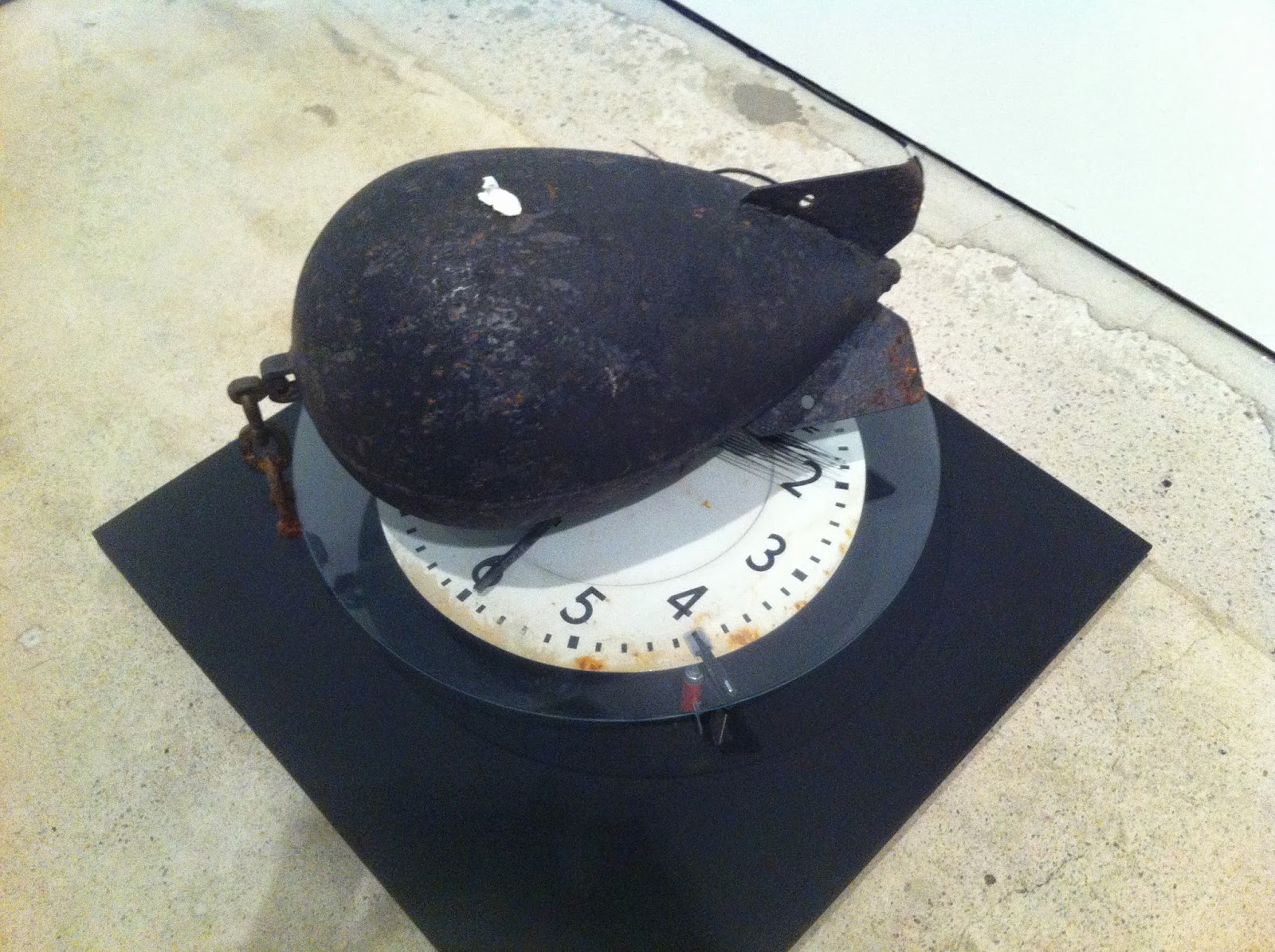
The second object collage I really liked is "A sheep called Albert". It is from year 2000 and I don't know if there was an Albert in the reality of 2000 giving some connotation to the reality (if we consider this collage to represent New Realism) but still I think this collage is interesting. It instantly makes me think about escape goats, white lies and in general the problems of communication and humanity. The objects of this collage are a bomb (deactivated I'm sure), clock-face, glass, clamps, plastic sheep and a dead pigeon. The poor pigeon is crushed underneath the bomb and every once in awhile that clock suddenly strikes and the voice is eerie in the big exhibition hall.


Here is a close-up of Albert. 


Third piece of art is "Breakfast with Foucault", also from year 2000. I guess to really get off of this collage it is necessary to know little something about Foucault and his ideas and essays and books about knowledge, power and also sexuality. I am not going to go on and on about them, I'll just say those are really interesting readings, if you like non-fiction!


Another close-up. I think this breakfast is delightfully weird and creepy.