The main star of this post is a Norwegian artist Theodor Kittelsen (1857 - 1914). His most famous works are illustrations for Nordic sagas and fairy tales, of which some he wrote himself. Many fairy tales of this era and from previous centuries were quite scary. They were more for adults' entertainment than good night stories for kids. So, the illustrations for these stories were often quite horrific too.
Kittelsen studied at a drawing school in Christiania (nowadays Oslo, the capital of Norway) in his teens and after that studied in Munich and later he got a scholarship to study in Paris. after this he returned to Norway. The Nordic nature was a source of great inspiration for him, especially combined with old folktales and sagas.
In the Nordic woods and remote lakes there are many a creature who can harm you. At least if we believe the old folktales. Different subspecies of trolls roam around and eat humans, and almost in every lake there is a creature called Näkki (in Finnish) or Nøkken (in Norwegian), who is a cruel and manipulative water spirit, and who lures humans into their doom. The real form of Näkki is hideous but it can change its form into a beautiful maiden or to a graceful white horse or to an innocent looking pretty little child. What ever is the best and most luring form to get a human into water.
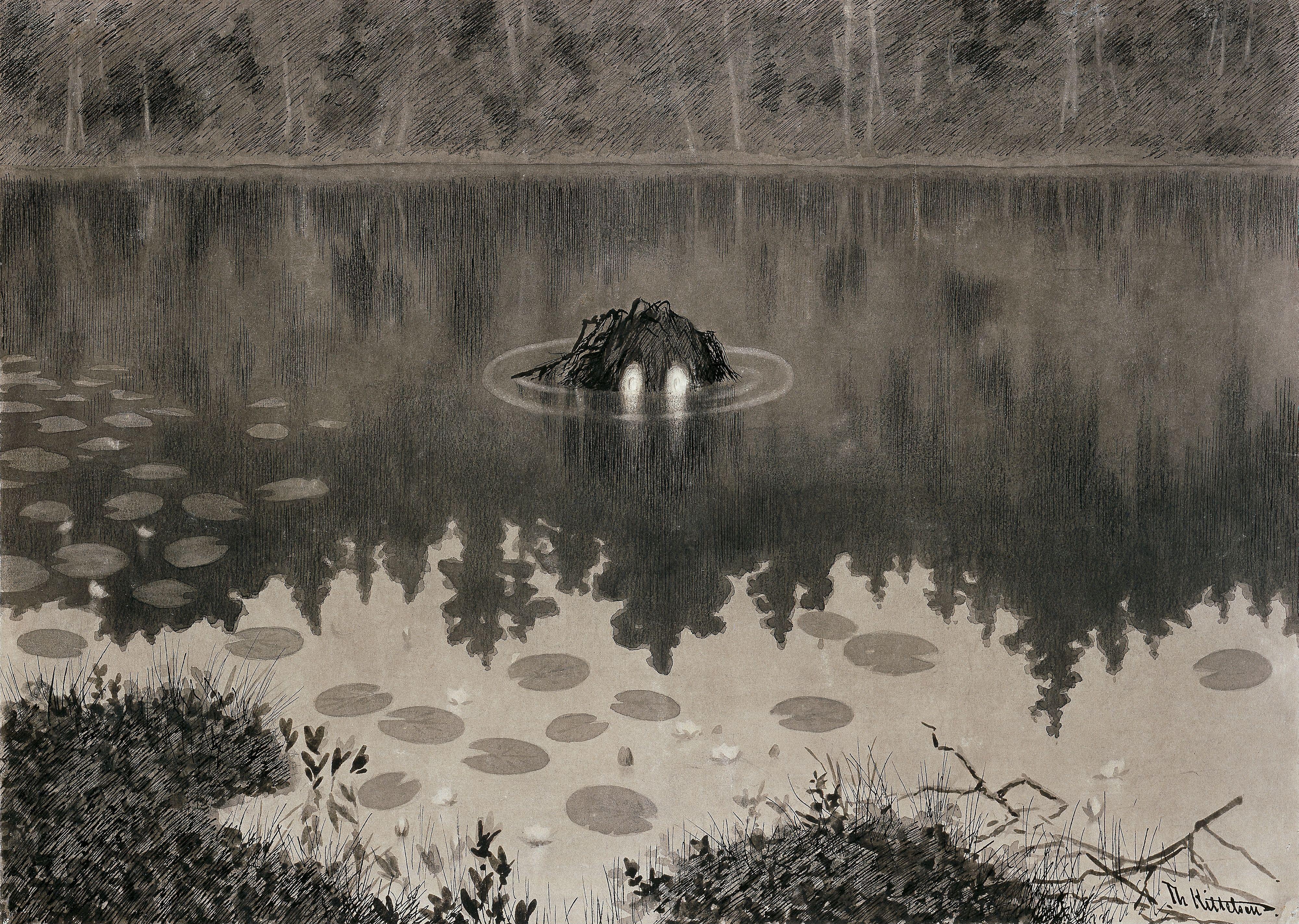 |
| Nøkken (The Water Sprite) by Kittelsen |
In Kittelsen's drawing on the right Näkki or Nøkken is not yet on a hunting mode. It is creepy, slimy and spooky. The lake (or pond) is so still it reflects perfectly the surroundings and the viewer can not see what Nøkken really looks like and what else might be lurking underwater.
To be a part of fairy tales, it is not enough to be a creepy creature eating humans. If everybody knows there is just some ravenous brute under surface, they won't go near water! Näkki must have something human in it, or at least it must have something humans would want.
In most Finnish tales Näkki is a divine violinist. And if you are brave enough, you might get Näkki to be your tutor, but it is cunning and tries to grab you into the water after the lesson. It is a very similar story with all those stories about men selling their souls to devil, if you think about it. They put themselves at risk and they have to be even more crafty than Näkki (Devil) in order to save themselves. Many of old folktales are more like instructions, how to deal with magical creatures, how to get what you want without being destroyed and devoured.
 |
| The Plague on the Stair by Kittelsen |
Folklore was not the only inspiration Kittelsen had. History and its sad events were intriguing too and according to numerous critics, Kittelsen's historical works of The Black Death are his best works in black and white.
As mentioned, Kittelsen did not only draw, he wrote too and The Black Death is made of fifteen poems and/or poetic prose sections with illustrations all by Kittelsen.
This human form of the Black Death was inspired by a real live person Kittelsen saw. For his creation he gave the name "Pesta", since in many languages the Plague is called Pest. In this most famous drawing of Pesta, she is creeping up the stairs. For me at least, the point of view is familiar from all those horror movies we have these days.
While I was doing some light research for this post, I noticed there are a lot of works by Kittelsen on
Pinterest, if you are interested. From there you can see how versatile Kittelsen was and that he also made many beautiful and delicate illustrations about fantastical creatures, little princesses and creatures of forest.
I saw Kittelsen's works at Ateneum, the Finnish national gallery. The exhibition
The Magic North is open till the end of September (more precisely 27th of September) and I do recommend it, if anyone is visiting Helsinki in near future. The exhibition features art from Norway and from Finland.
The Magic North is not merely about trolls and fairy tale drawings, even though the name of this exhibition might indicate so. It is more about the general atmosphere of the turn of the century, the dying gasps of Romanticism and roars of Nationalism.
 |
| Portrait of Edvard Munch by Gallen-Kallela |
Of course there were many trends in art in the end of 19th century and in the beginning of 20th century, but in Norway and Finland (though I should say the Grand Duchy of Finland because back then Finland was under Russian throne) Neo-Romanticism and Nationalism were more important than lets say Impressionism. I have written a bit on this subject on
this post about another artist from this same era.
So, the exhibition The Magic North has many paintings of nature without any visible indications of trolls or other fairy creatures. There are also many portraits of peasants and of other artists. One of my favorites is The Portrait of Edvard Munch by Akseli Gallen-Kallela, both men were very famous artists throughout Europe and they used to hang out together.
I think this painting shows a more melancholic side of Munch than his own self-portraits. Many of them have this slightly extravagant illusionist sort of feeling, or at least I feel so. I have written about two paintings by Munch in
another previous post. They are not self-portraits, though.


