Showing posts with label art. Show all posts

Monday, 4 September 2017

Gothic Art in Spotlight: mythological creature of Finnish folklore

After this post I shall be taking a one month pause from blogging. It's because of two reasons; Firstly, I already know that September will be very busy for me. Secondly, I need to rethink the concept of my art posts. Evidently the pieces I've lately introduced are not really goth-y.
A photo of a town, seen through a window
So, for the next month, I'm not writing myself, but I will still read other people's blogs, though!

The piece I shall now introduce is a sculpture. The subject is Ilmatar, which is a mythological creature (often like a sort of minor deity) of the old Finnish folklore. Ilmatar means a female spirit of the air. As you can see, the figure is very slender and she has feathers instead of arms.
Statue of a mythical creature called Ilmatar, close-up
Sculptor Kaj Lindgård made the figure and artist & novelist Katariina Souri made the mosaics.
Statue of a mythical creature called Ilmatar, front view
What appeals to me is how this statue balances between being human and being alien. It is like a very cute version of some of HR Giger's alien female characters.

I also think that the position of this work in the gallery was well thought. It would not look the same if it was against a white gallery wall, right?

Cultural background of Ilmatar


Now, prehistoric Finnish folklore did not have a strict dogma; the geographical are which is now called Finland was populated sparsely and different villages had slightly different beliefs. Some villages had certain stories and the other villages some other stories. It's a bit like Ancient Greece where there was no 'one collection' of the mythical stories and beliefs before Homer and his Iliad and Odyssey.
In Finland, the majority of the old folktales were not in the written form but they were always sang and learned by the ear. In the 19th century, when European culture came more popular in the north, old Finnish folk poems started to disappear.
Statue of a mythical creature called Ilmatar, close-up
This worried some people and so people started to record (in written form) these folk songs. The most famous of these is Kalevala by Elias Lönnrot (1835). Kalevala inspired J.R.R. Tolkien when he was creating the folktales of the Middle Earth, by the way. The language of the elves even resembles Finnish.

Now, Kalevala, like Iliad and Odyssey, is a one man's edition of all those stories from all those areas. Lönnrot chose certain versions and put them into a time order. And: he used mainly the stories of one or two singers. This means that we have a very narrow scope to the old tales.

In Kalevala, the spirits of the air are not heroic adventures but they are mostly beautiful creatures that are sometimes associated with the maidens of the North (who are mostly prizes for heroes). Which actually is an interesting parallel for this sculpture by Lindgård and Souri; it is a beautiful object we ogle. 

Monday, 21 August 2017

Gothic Art in Spotlight: Uncanny insect statues

I haven't seen goth-y art lately, and that is the main reason why I haven't posted for a while. These sculptures I am now introducing are not that goth either, but they did appeal to my taste.

I saw these works in an exhibition at Gallery Gumbostrand Konst & Form. They are made by Kristian Venäläinen. His works are often sculptures, but his technique varies a lot.

These statues resemble a dragonfly, who for some reason is digging itself into the groud. They are odd, and most people do not like insects that much. Insects are thought to look a bit too alien, I guess.
A statue that looks a bit like a dragonfly
Resembling an insect is not the most off-putting quality of these sculptures. The unnerving part is that if they are insects, there is something wrong with their structure. The wings seem to be pointing the wrong way.

Especially in this large sculpture the form is uncanny. The wooden wings are huge and spiky. And to me it looks like they are pointing to the wrong direction. But maybe it's just me?
A photo of a sculpture with wooden wings.
What do you think? I think the way the wooden part is attached is very intriguing. It looks a bit like a helmet, doesn't it?
A statue with wooden wings, photographed from another direction.
Venäläinen says he is inspired by the randomness of nature and that is very visible in these works. Their names are Evo as in the word evolution,  Otus and Olio (both can be translated as 'a creature') or Elo which means 'to live' or 'living'.  There were several statues, so their full names were Evo IV, and so on.
Three sculputers and a man standing close to them.
In this photo I used a random person as a measuring stick for the statues.
The smaller sculptures are constructed of metal and black clay. The big ones are made of some other clay for which I do not know the translation. But its consistancy is suitable for making huge objects.

The next post will be out in two weeks and it will feature another statue I saw on my vacation. It's not necessarily goth but it certainly is a bit odd.

Friday, 19 May 2017

Gothic Art in Spotlight: grotesque installations

I haven't posted for a while because this month has been very busy for me. I am going to move to a new apartment by the end of the month and today I am going to get my eyes operated. In the future I shan't be needing glasses to be able to see things around me! Obviously, I am rather excited (and agitated) about it. Hopefully everything goes alright! But now, to art:

A week ago I visited Tampere, my old university city, and spent one afternoon looking art. I encountered the grotesque installations and sculptures at an art gallery called Galleria Saskia. The exhibition is free, open daily and you can see it until the end of this month. 

The exhibition features two Finnish artists, Heli Ryhänen and Anne Meskanen-Barman. These both ladies have made a substantial career and the all the sculptures in the exhibition give the viewer an uncanny feeling.

Regardless of the whole exhibition being intriguing, I shall concentrate on only one installation by Meskanen-Barman: High Tea (2017). The installation consists of a table with food and teacups on it, an armchair and a lamp. When one enters the room, it looks quite harmless. But as one walks nearer, one sees that the high tea is not that delicious-looking.
The interpretation of this work is ambiguous. Therefore, it works as a reflector for the viewer. How do we react when a face is poking out from a sophisticated teacup? 

The faces in the teacups resemble the way one sees one's reflection of a teacup when one is about to have a sip. On the other hand, one seldom looks that agonized when one is enjoying high tea...
And how about those delicious little cakes? If one looks closely, one notices that the surface looks like a human nipple. How to interpret that? Is the installation trying to raise conversation about how in our culture sweet treats and cakes are often used as a metaphor for sexual passion or courting? Or are they there for the sake of shocking people?

What are your interpretations of this work?

Sunday, 2 April 2017

Goth Tourist in Glasgow

On my little holiday in Glasgow, I indulged myself by visiting various art museums. But, not all darkly inclined people are such art museum freaks as me, so I am going to feature just four sights that are rather gothy and are available all year around. All of these also happen to be free of charge.


The Kelvingrove Art Gallery & Museum


The Kelvingrove Art Gallery & Museum are an extensive collection of art, natural science, and history. The exhibit space is filled with paintings, statues, taxidermy animals, armors and what not.

My personal favourite of the artworks was this distressed Harpy by Mary Pownall (1902). The title of the work is The Harpy Celaeno. It was almost impossible to take a photo of the statue, for some reason my phone's camera refused to focus on it. Spooky.

The harpy is groping her chest, her claws bite into her own skin, and her face expression implicates sorrow and pain. Harpies are usually depicted without hands and often in groups, so this is an unusual sculpture. It is much more human than is customary.

From 1st of April till 1st of October 2017 they feature an exhibition of superheros and comics. It looks very interesting but unfortunately I did not get to see it.


Glasgow University & the Hunterian Museum


Anatomical samples in jars.Magnificent Gothic architecture of the University is worth checking out, and so is the Hunterian Museum inside it. The museum is named after William Hunter (1718–1783), who was a former student of the University and a keen collector of all things marvelous. His collection was the base for the museum. Collection ranges from the artifacts of Ancient Rome to Physics inventions.

The most macabre part of the collection is the Anatomical and Pathological Collection. Many of the samples are human but some are disfigured animals with more heads and feet than is usual.

The Glasgow Botanical Gardens


Glasgow Botanic Gardens are a marvelous place but for goths and other macabre folk the Botanic Gardens offer a whole room dedicated to killer plants. These plants are carnivores and on my visit I learned that there are 5 different method categories for the plants to trap their pray. One of them being 'lobster pot traps which use inward and downward pointing hairs to force pray to move towards a digestive organ'.
Carnivore plants.

I doubt these particular carnivorous plants in the photo use that method of 'lobster pot traps' but they sure are beautiful. The other rooms of the hothouses were very nice too.

Glasgow Necropolis


Last but not least, the Glasgow Necropolis. It is a Victorian garden cemetery and there are many beautiful and ornamental gravestones and memorials. The Friends of Glasgow Necropolis organize guided tours and it is a good idea to participate one if possible. The Friends of Glasgow guides give depth to your visit, because they can tell about the history of the graves and the cemetery.

If your visit doesn't match with the tour program, another thing I can recommend is to buy a book they've published: The Glasgow Necropolis After lives – Tales of Interments by Ruth Johnston. It costs £ 8 plus delivery but it does make your visit way better. Me and my friend had that book with us when we went on our visit and it was marvelous.
A woman in a cemetery.
We started on the recommended route up the hill and every time we saw an interesting gravestone, we searched its photo from Johnston's book. The book includes 150 most interesting graves and Johnston has collected all sorts of facts about the artwork, the lives of the people who are buried there, and so forth.

I hope these tips will be helpful for another goth tourist in Glasgow!

Wednesday, 5 October 2016

Gothic Art in Spotlight: Monsters of Niki de Saint Phalle

In the end of August I went to see the exhibition of Niki de Saint Phalle (1930 - 2002), that had just been opened in the art exhibition space called Taidehalli. It took me this long to write about it because September was a tremendously busy month for me.
A detail of a work by Niki de Saint Phalle
If you google Niki de Saint Phalle, the first images you'll get are photos of big, colorful, energetic and positive sculptures of female figures. And that was my narrow perception of her works before I went to the exhibition in August. In there I learned that a Monster is a reoccurring theme in Saint Phalle's works and many of her sculptures are dealing with negative experiences and trauma. Seeing this exhibition made me want to read Saint Phalle's autobiography.

Saint Phalle was a controversial and a brave woman, who had the courage to question narrow structures of the society and of the ways of making art. Instead of becoming an obedient housewife in the 50's, she started to create art and in the 60's she invented the "Shooting Paintings". They were large 3D structures with bags of paint inside them. Then the artist Saint Phalle and often the person who commissioned the work would shoot at the painting with a gun and thus break the bags of paint, which would create colorful areas on the painting. They would stop shooting when the work looked ready for them.

Even though Saint Phalle's working techniques are intriguing, the works produced by shooting were not the ones that interested me the most. For me some collages of found objects and paint and other materials were the ones that somehow reeked of grim and sinister aesthetics. One of them was a work with various names: Tyrannosaurus Rex/The Monster/Tir Dragon (Study for King Kong).
Saint Phalle has a distinguishable naïve style and this huge lizard is in a way quite cute. The details make it more sinister. The creature is constructed of crocodile figures, skulls, toy guns, and dismantled baby dolls. Unfortunately the close-up is blurred, the exhibition was very crowded and it was not easy to take photos. I hope you can still see there are crocodiles, a skull, and some toy guns.
As mentioned, monsters are a reoccurring figure in Saint Phalle's works and many of them deal with a childhood trauma. Saint Phalle has revealed that her father sexually abused her when she was 11 years old.

Occasionally Saint Phalle also depicted herself as a sort of a monster in her art, but that was about her own life choices and how they affected her family. After all, she pursued a career that in the 50's and the 60's was not for women and during that time period some people (many people!) thought she was a bad wife and a bad mother.

The work I liked the most in the art exhibition was named Le Château de Gilles de Rais (The Castle of Gilles de Rais). Gilles de Rais was a French nobleman from the 15th century. He fought in wars and was honored as a brave and righteous man. He retired from his duties as a young man and almost twenty years later he was sentenced to death as the first serial killer. According to the history books, after his heroic career he had abused and killed at least 200 children.

Saint Phalle herself is a distant relative of Gilles de Rais through her fathers side of the family. She was fascinated by how a man who was almost a saint could also be or become a satanic creature who enjoyed the suffering of children. The photo in the beginning of this post is a detail of this Castle. If you look closely to it, it features molested baby dolls and lizard-like creatures. The sculpture is much more grim if one knows the story of Gilles de Rais.

It would be highly inappropriate to say that "I hope you enjoyed this post!" but I do hope you found it at least interesting and maybe it will encourage you to explore the not-so-well known works of artists you know. There might be fascinating surprises!

Saturday, 13 August 2016

Gothic Art in Spotlight: Ghosts and creepy sculptures

The road trip in July took me to the city of Joutsa in Central Finland. There resides the Art Center Haihatus (could be translated as a daydream or a fanciful idea). It is an artist run art center and they hold every summer a grand exhibition. Artists can also apply for residency in Haihatus.

The exhibition area consists of three buildings and their garden, and a field area next to them. The place was filled with all kinds of works but mostly installations or statues, like this dragon like creature:
The three buildings have names, Haihatus, Utopia, and Fantasia. In Utopia was the main exhibition, or at least I felt like it. This skeleton is a small detail (it is the size of a two-year-old) of an installation that filled one room. I'm not sure if it is done with papier-mâché or is it some sort of clay.
In the attic was a grand installation by Jouko Korkeasaari. The name of the work is "Ett spök, spöket, spök" which is oddly almost Swedish. It almost says "A ghost, the ghost, ghosts", like in a dictionary but it is spelled wrong. I am pretty sure that is the point, because these creatures looming between hanging sheets are almost like ghosts, but there is something wrong in them.
I think the one above seems to be afraid of the viewer. Usually ghosts are supposed to be the scary ones.
This too seems like it is reserved. In the back of the room was a window open, so the sheets moved a bit in the breeze. Very spooky!

In the building called Fantasia we found the most bleak or grim works. The rooms were very dark, there were practically no lights and I guess I missed some information board or something because I could not find information about who made these works. Nor have I any idea what the titles of the artworks are.
This here is some sort of a mummified troll. Not real, of course. The text says "Please do not feed the trolls". Underneath was placed a typewriter, perhaps as a symbol for making up stories and fairy tales.
This here is a very old basin for bathing little children. The legs are from an old table and the basin is filled with bones. Clearly bones of a quite large creature.
No idea what is the point of this but it is cute in some very odd way. The feet have little paws so it sort of looks like a very abstract version of a pet.

I hope you found these works interesting! Next time I'll be back with another Creepy Reads Review.

Tuesday, 2 August 2016

Creepy and geeky art treasures at the Serlachius museums

As I promised in my previous post, I am going to continue writing about my art road trip. After the city of Tampere and Ron Mueck's installations our next stop was at Mänttä-Vilppula, the city of art as they are called. This nickname came because a very influential family Serlachius lived in Mänttä-Vilppula and the members of this family loved art, especially a man called Gösta. The Gösta Serlachius Fine Arts Foundation was created and the artworks they've acquired are displayed in Serlachius museums at the city of Mänttä-Vilppula.

Art Museum Gösta


The art museum is named after Gösta. They have a new extension to it, Gösta's Pavilion and in there they feature contemporary art. This summer they have a big exhibition of Mark Wallinger's works, open until 9th of October 2016. Wallinger is a painter, sculptor and a video artist. His works, materials and style varies a lot.

This are from the series of id Paintings. The inspiration came from Sigmund Freud's theories and the concept of id and I presume also from the idea of subconscious. They look like huge versions of the Rorschach test. They are taller than an average human, and in the exhibition room there were about 20 of those paintings. It made a person feel really small.

The Rorschach test is a test based on association and interpretation. The patient (or a person examined) looks at cards with ink spots and tells what she/he thinks they look like or symbolize. These interpretations are then seen as sort of messages from the persons subconscious and from them others can try to judge if this person is having stress or for example mental problems.

I would like to note that I have not studied psychology and that short explanation is a simplified and possibly quite crude way to describe the Rorschach test. I personally think that doing/playing this sort of an association game can be fruitful but people really should pay attention to the fact that humans do not share all symbols: for someone a butterfly is a joyful thing, for another one it symbolizes fragility.

It was actually quite fun to start to really look at these paintings and try to analyze and imagine what all those shapes formed. In this painting I saw two mountain hares hanging from something. Possibly they are today's catch and someone is about to make dinner of them. What do you see in this painting?

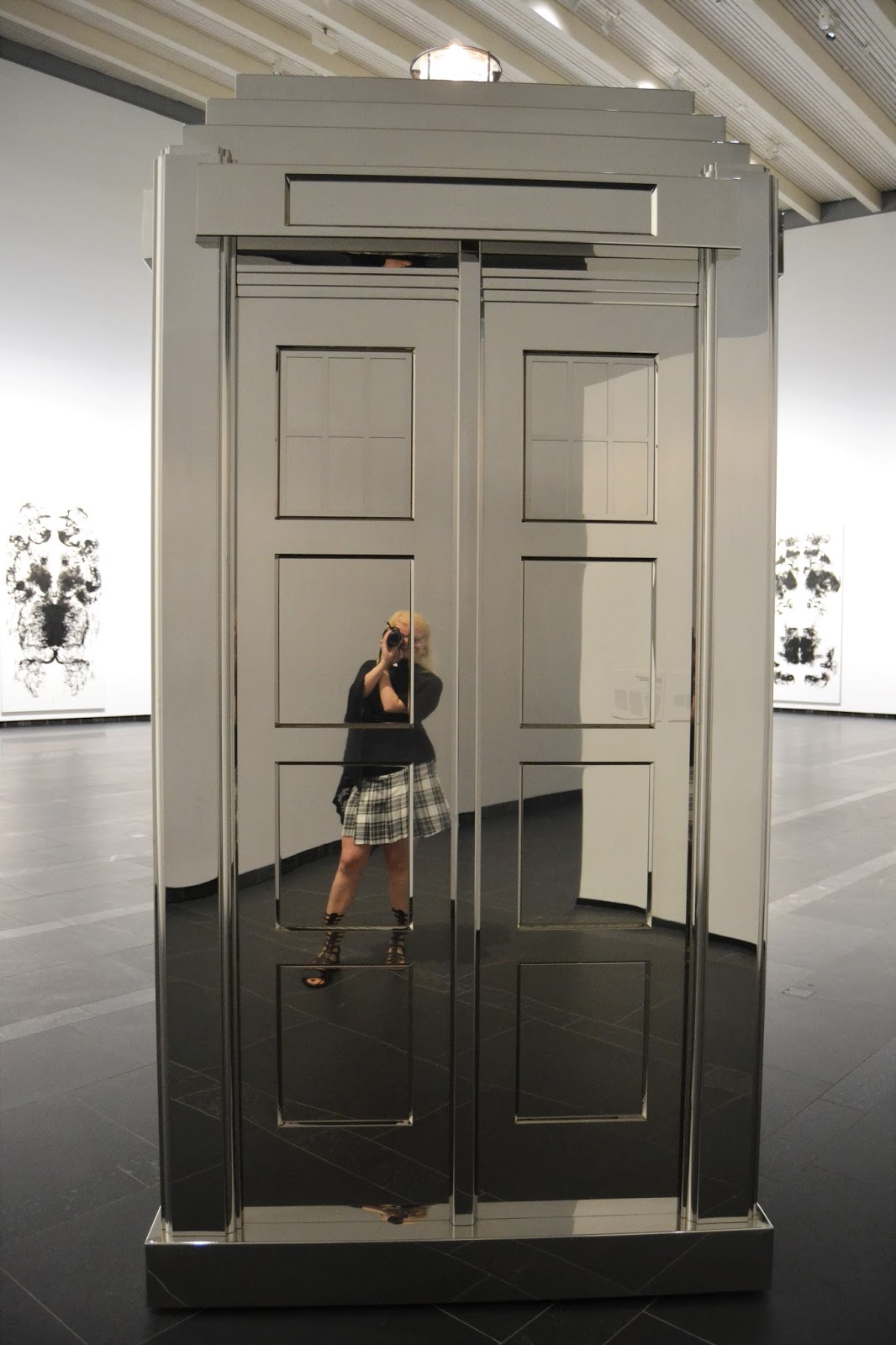
The id Paintings were made 2015. This sculpture named Time And Relative Dimensions In Space is from year 2001.
As I mentioned in the previous post, there was something that reminded me of Doctor Who. If you picture this shiny box to be blue and have the words Police Public Call Box on it, you'll understand.

Here is me next to it for measurement. Its outer dimensions (aka size) are almost exactly the same as Tardis has. They might even be the same, alas I have never seen Tardis or the props they have for the TV show.
I did not touch it because I am a law abiding art museum visitor and it was highly prohibited. Wanted to, though.

Museum Gustaf


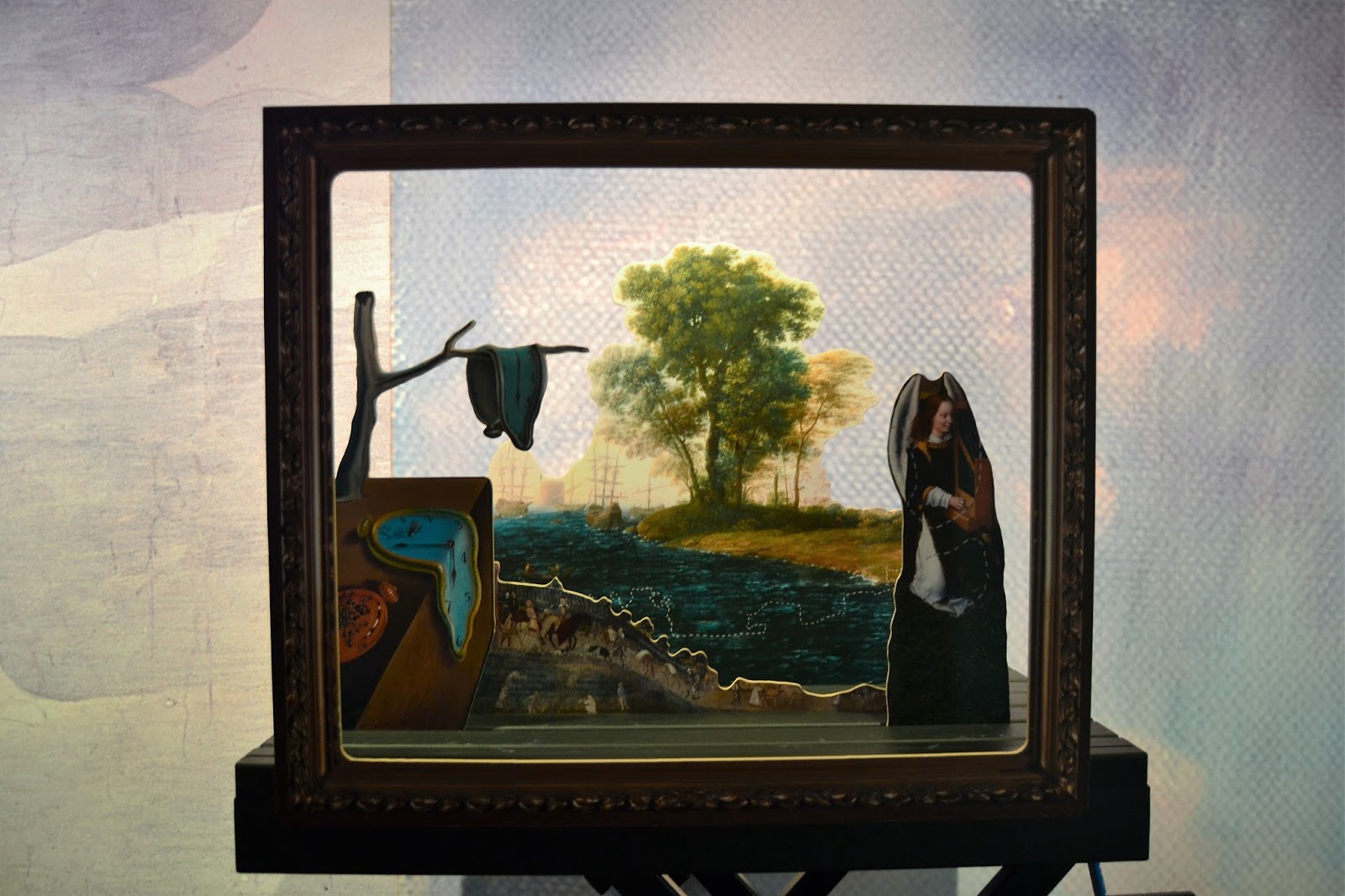
Those were some works at the Gösta Art Museum. In Mänttä-Vilppula there is another Serlachius Museum named Gustaf. They usually have exhibitions about history and technology but this summer they also had an exhibition called Landscape. It was an interactive exhibition in which people could learn about the history of landscape art, and create their own landscapes of the pieces of famous landscape paintings.
From the photo above you can see the entrance. Maisema means landscape and on the right there are pieces of famous paintings. Inside the room there were sort of tables with frames. On the other wall there were replicas of famous paintings, the pieces of paintings for constructing one's own landscape (in the shelves), and video screens. The videos were about landscape paintings and their history.
Here are two installations I made. The other one is with Dalí's watches and a random angel.
And the other one is a mix of some winter paintings. A more classy combination, I'd say. Do click the images for a larger view and better details. I took these photos with a real camera, not my phone, so the quality is not that devastatingly bad.
I hope you enjoyed this post. I had fun at the museums and fun writing about them, and I do hope some of that happiness and enjoyment shines through this post.

Next time: cute and macabre art from the next destination on my road trip!

Tuesday, 26 July 2016

Gothic Art in Spotlight: Uncanny Giants of Ron Mueck

Last weekend I went for an art road trip in a small but selected company. This means that we left the capital of Finland and traveled through ten art museums and other summer exhibitions during three days.

The route took us from Southern Finland to West, the city of Tampere, and then to Eastern Finland. You can roughly see the route here in this map in purple, it's unimaginatively named as 'Art Road Trip'. The distance me and my entourage traveled was about 600 km (370 miles).
Map made with karttaikkuna.fi
The places we visited on Friday were:

Riihimäki art museum
Hämeenlinna art museum (Riihimäki and Hämeenlinna are the names of different cities)
Sara Hildén Art Museum

Sara Hildén (1905–1993) was a Finnish businesswoman and a patron of arts. She started an art foundation (named after her) in 1962. The foundation concentrated on modern art but they do hold exhibitions of contemporary art these days. This summer they are hosting a solo exhibition of Ron Mueck. Previously they've had solo exhibitions of many famous artists, among them Andy Warhol.
Mueck is an Australian artist, and has made only 40 works. 10 of them are displayed this summer at Sara Hildén Art Museum in the city of Tampere. The works are extremely life-like sculptures that are in some way out of proportion. They are either outrageously large and hence uncanny or very small. 

I found the exceptionally large works delightfully disturbing. among them were a giant couple under a parasol, a human-sized dead chicken and a baby the size of a whale. 
The sculptures are detailed, they have individual hairs and pores and everything. This might be a weird thing to say, but the sense of 'flesh' was very strong in the exhibition. 
Unashamed I used random people as measuring sticks for these art works. The sculptures would not look so exceptional, if you could not understand the size of them. I think this gigantic baby is fascinating and at the same time repelling. 

What do you think of Ron Mueck's art?

Next week: the treasures of Serlachius Museums, among them something that will probably remind you of Doctor Who!

Tuesday, 12 July 2016

Gothic Art in Spotlight: The everyday cruelty in Jarmo Mäkilä's art

Some time ago I went to see the art exhibitions at HAM, Helsinki Art Museum. There were a couple of big exhibitions and a couple of small exhibitions in their facilities. The exhibition that made my little goth heart shiver the most was the exhibition From Heino With Love. Heino is the surname of a family that began to collect contemporary art. Their love for art gave birth to the Heino Art Foundation. This exhibition in HAM is the first time the public can see a glimpse of their extensive collection. The exhibition is on until 28th of August 2016.

Bleak and cruel childhood


The exhibition From Heino With Love featured many interesting contemporary artists but what really caught my eye on my visit to the museum were the works of Jarmo Mäkilä. His works often show the mundane cruelty of our everyday life. Mäkilä has made sculptures, paintings and installations. Many of his work have a sort of a horror film atmosphere, but some are terrible in a more documentary sort of way.

The piece I want to show you is named First Day at School (2007–2008). It is an installation of a miniature model of a school building. On the other side there is either a trail of toys leading to the school, or quite possibly escaping from there.
On the other side the building there are visible marks of violence. The windows are smashed and there are signs of a fire or an explosion.
For me this is a bleak description of a child's feelings when he/she is forced to go to a scary new facility for the very first time. Very big schools with not enough staff and too many bullies can seem like a hostile place to be.

What thoughts spring into your minds?

Art around the city


What I really like about HAM is that they also organize exhibitions outside the museum. At the moment one of the old boulevards for pedestrians in the center of Helsinki is the showplace for an installation by one of the best known contemporary artists: Japanese Yayoi Kusama.
Kusama has wrapped the trees into polka dots. The whole street looks like this. A bit like Wonderland, isn't it?

HAM also has an exhibition room or a window in the nearest metro station (simply named as HAM metro). It is a sort of a glass cage for the art on the platform so people waiting for the next metro can look at some art while they are on the platform.
At the moment HAM features large paintings by a Swedish graffiti artist Kaos.

I hope you enjoyed this post!

Thursday, 9 June 2016

Gothic Art in Spotlight: The Black Paintings of Goya and a trip to Madrid

I spent the last full week of May in Madrid, as a sort of a summer holiday because I am going to be working the whole summer (of which I am glad!). In my previous blog post I already mentioned that this spring would be very busy for me and I was not wrong. I have finished my studies and before I traveled to Madrid, the capital of Spain, I had emptied and cleaned my apartment in Tampere, the city where my (soon to be ex-)University is. I returned from Madrid  two days before my new work began and for the past week I've been still very busy, learning the new job.
The view from the hotel room in Madrid
In Madrid I visited many amazing art museums and saw many great paintings and statues by famous and not so famous artists. The works were beautiful or thought-provoking but not something that was hitting that "goth spot", if you know what I mean. :) The most goth paintings I saw on my trip would be Francisco de Goya's "Black Paintings". I saw most of them at the Museo del Prado, the distinguished art museum with the largest collections in Madrid. They had a whole room full of Goya's grim and ominous paintings.

The Black Paintings are paintings Goya (1746–1828) made between 1819 and 1823. He used much darker colors and shades compared to his earlier works and most importantly, the paintings depicted sinister and horrifying things. This is a painting called "Saturn eating his son" and the name is quite explicit. Saturn, the father of Zeus and other gods of Ancient Greece, is devouring his own son because there was a prophecy that one of Saturn's own children would kill him. So he would eat them all. This is a striking and obscene painting.
Source
I must admit that I've never been a fan of Goya and the Black Paintings do not make my heart shiver nor do they put me into awe. The subjects of the Black Paintings are interesting but something in Goya's style just isn't suitable for me. Goya also made some paintings of witches and their grim rites in the end of the 18th century. Their colors are lighter but subjects are not. In this painting a group of witches are having a feast with the incarnation of the devil or another demon and they are offering dead or ghoulish children to him. Or at least that is how I interpret this scene.
Source
These paintings could easily delight and interest goths. The macabre and twisted elements are fairly visible and they have a sort of a timeless vibe in them, with the mythical themes and folklore-ish subjects.

As a side note: Museo del Prado is now having an exhibition of Hieronymous Bosch and his works and it looks like it is amazing. Alas, I could not see it because I had to return to Finland before the exhibition opened. The exhibition is the biggest exhibition of Bosch this year. If you happen to be in Madrid in near future, that Bosch exhibition is definitely worth checking out!

Saturday, 30 April 2016

Personal update and some uncanny art

Once again a month has passed by. I have been working on my thesis relentlessly and I am happy to say that in two weeks it shall be finished and I will graduate this semester! That will mean that I have more time to write this blog. ^__^ Another thing that has been preoccupying my free time for the past couple of months is the search for an apartment. In the beginning of June I start working in a different city and need to find a place to live. I am really excited because a new chapter is beginning in my life.

For the past couple of months I have visited several art exhibitions but they have not often suited the themes of this blog a.k.a. the artworks I've seen have not been extremely "goth" nor have they represented darker aesthetics. This installation is something I would like to feature. I think it is rather uncanny.

This installation was made by Finnish artist Mia Hamari. Another work of hers was featured in this post in January. The name of this work is "Manual, Siberia, Jester, Party". It is made of two figures. A more human-like creature and an animal with a human face. Hamari draws inspiration from dreams and the subconscious. Her works often feature a human-animal metamorphosis. In this work there are also mechanical/clockwork aspects to them, since the other one has wheels instead of back limbs.
This work was exhibited at the Gallen-Kallela Museum. Gallen-Kallela is one of our national artists and the museum is his old home turned into an exhibition place. There are changing exhibitions and this work of Mia Hamari can be seen till the end of May 2016.
As you can see, this artwork is made of mixed materials, among them bronze, wood and parts of animals. The animals Hamari uses in her art have died in accidents. She has also used human parts like hair and eyelashes. Presumably they are of her own or donated to her.
This smaller statue is the size of a small terrier or another dog. What I really like about this installation is that the expressions on both the creatures' faces are a bit ambiguous, one can easily interpret several different feelings. This way the work can express different feelings and atmospheres, depending of the viewer. The small one is looking up and the taller one has closed its eyes. Though the small one has no pupils in its eyes so nobody knows if it can even see. Very uncanny.

I hope you liked this installation of Mia Hamari!

Thursday, 7 January 2016

Gothic Art in Spotlight: In a sleep so deep it might be death

Happy and prosperous new year!

Today in Gothic Art in Spotlight I wish to write about an artwork by Finnish sculptor called Mia Hamari. The artist prefers to be called a sculptor but she creates beautiful paintings too. The work I am concentrating to is actually an oil painting on wood with two small wooden sculptures attached to it.

The work is called Valvojat which could be translated as the Supervisors or the Guardians or even as the Overseers. It refers to the idea that when a human is sleeping, spirit entities, like guardian angels for example, are guarding the sleep and that no harm is done to the person sleeping.

This is a very bleak painting. In the museum's info sign it read that the painting depicts "a sleeping boy". I am not sure how eternal that sleep is, if you know what I mean. Even more uncanny is the point of view: the boy looks like he is watched from an adult's viewpoint, while the boy is lying on bare ground. If one looks at the painting straight from the front, that other wooden figure looks like a melted wax candle, you know the kind people used to have in a wake.
Actually, the wooden sculptures are like small protecting totems. The other one at the top corner is shaped to resemble a stuffed toy dog and the other is slightly more ambiguous. It could be a doll or some sort of a toy bear. The face is distorted and a bit creepy. The skin of the boy looks damaged in some places, hinting of violence, and makes this painting ever so disturbing.
The painting is quite large and this painted little boy is as tall as a living 7-year-old. Or at least I thought so at the time I saw it, I have no idea how tall an average 7-year-old is. It was an impressive painting in the Oulu Museum of Art. This artwork was made during the years 2009 and 2010. The artist's own son was the model for this boy.

This ominous sleep the boy is in reminds me of old shamanism and pagan religions that were flourishing in the woods of my homeland centuries and centuries before the actual state of Finland. Shamans would often get themselves into trance to travel to the lands of dreams and even death to seek knowledge and help from various spirits.

Thanks for reading, and do tell in the comments what you think of this little boy!