Showing posts with label review. Show all posts

Friday, 7 April 2017

Creepy Reads Review: Grimm Tales by Philip Pullman

This months Creepy Reads Review presents to you Grimm Tales for Young and Old (2012) by Philip Pullman. Or so it says on the cover.

I saw this book at the Glasgow Airport, my flight was due in a couple of minutes, and I wanted something to read on the flight. The cover of Pullman's book was pretty and the back cover stated following praises:

'Gripping ... A clear and humorous retelling, with added sprinklings of wit ...'  – Sunday Telegraph
'Told with extraordinary toughness and savagery' – Andrew Marr 
'Magical ... This wonderful retelling is set to become a classic in its own right' – Sunday Times

From those quotations I assumed that:
a) Andrew Marr is praising Pullman's way of writing.
b) Retelling is creative work in which Pullman has made new version, his unique versions, of the Grimm's fairy tales. How else could the book 'become a classic in its own right'? The old fairy tales are already classics.

Sadly, my presumptions were wrong. The stories in this book are mostly just a regathering of the old stories. Pullman hasn't altered the Grimm's fairy tales much. In many cases he has merely gathered his favourite versions of the old printed tales. In some stories he has made minor alterations but I have to say they seem irrelevant. It doesn't matter whether an evil stepsister ate cake or chocolate cake, especially since chocolate doesn't become a symbol or motif for anything.

Pullman claims he has altered some text in order to better them but I do not really see it. He hasn't been bold enough with the alterations and therefore they lack significance and individuality. The narrative style is not reaching the 'Pullman way of writing' and hence any writer could claim these texts as his/her work. I expected a little more from a famous writer in the 21st century. There are already so many printed versions of the Grimm's fairy tales, why did we need this one?

One of the most often heard quotes from Pullman (which, of course, is not really his) is that all stories are stolen and all stories have already been told. That is quite true, but to be able to retell a story without slipping into mere plagiarism requires some effort.

Honestly, I was disappointed. I would not have bought this book if I had known that these stories are not really rewritten. I have read several version of Grimm's fairy tales in several languages and the Pullman collection does not bring anything extra to the stories. I assumed this collection would've been more like the My mother she killed me, my father he ate me short story collection or like The Bloody Chamber and Other Stories by Angela Carter, in which Carter has really rewritten the old fairy tales, giving them intriguing twists. But no.

The good sides of Pullman's book


I was disappointed, because the back cover praises were misleading. If this is put aside, there is nothing wrong with the collection. Firstly, the cover is pretty. Secondly and more importantly, in the end of each story is a short background report about it. It tells what type of a story it is, and from what year this particular version is (or if it is a mix of two old versions).

I appreciate the background report, and for that the Pullman collection is great. Though I must point out that in some of the background reports there are Pullman's own 'observations' and opinions of the story lines and the morals and those remarks seem often unjustifiable and sometimes even unprofessional.

So, I can recommend the Grimm Tales for Young and Old 'by' Philip Pullman for those who are looking for Grimm's fairy tales in a pretty cover.

Thursday, 23 March 2017

Goth Tourist in Edinburgh

This is the first post about the goth-y things I experienced on my trip to Scotland. Next week I'll write about goth-y things in Glasgow but now we'll concentrate on the capital.
On a day trip to Edinburgh, I and my friend visited two distinctly goth places. First the Surgeons' Hall Museums and then the pub with Frankenstein theme.

Surgeon's Hall Museums


I can wholeheartedly recommend this place. The Surgeon's Hall Museums is in plural because it consists of two museums and ole collection: Wohl Pathology Museum, the History of Surgery Museum and the Dental Collection. The museums have samples and curiosities beginning from the 18th century all the way to the present day.
Alas, one could not take photos in the museum but I'll just say that the exhibition rooms were amazing. There were thousands of samples in glass jars and also several interactive pieces. In one of them you get to participate to one famous postmortem, in another you get to try how much precision surgeon needs in her/his job.

I would also like to add that the members of the staff were very nice and helpful. Especially that lovely lady who was working in the ticket shop at around 1 pm on Saint Patrick's Day; you made our visit more than perfect, thank you!

Frankenstein Pub


I adore Mary Shelley's novel Frankenstein; or, the Modern Prometheus and also most of the movie adaptations of it. So of course I and my friend just had to go to the pub with Frankenstein theme!

This pub is goth, horrifically funny and quite kitschy. They had the movie version from 1931 playing on loop on all the televisions they had in the place and they had all sorts of cutely tacky decorations on the walls.

On the entrance they had this huge statue of the Creature. I tried to hold hands with him but he seemed a bit distracted the whole time.

If you check the pub's Twitter, you'll notice they have among other things Harry Potter themed quizzes.

Other tips for goth tourists


I also want to hint about three goth-y things in Edinburgh. We didn't have time for these this time, but especially the Ghost Bus Tour seemed very interesting. We sighted one bus on our way and it looked very charming. Alas, it was all dark so I didn't get a decent photo of it.

Ghost Bus Tours


The Ghost Bus Tours are not just an Edinburgh thing; they also have tours in London and York. This is a horror comedy show on wheels. They promise to take the travelers to the most grim and famous sites of Edinburgh

The Real Mary King's Close


The Real Mary King's Close is a prize winning tourist attraction. The 'main ingredients' are 17th century streets that were sealed away for some reason and guides in character costumes. On the guided tours people get to see the 17th century life as if it was frozen in time. During that era, life could be rather brutal.

The Edinburgh Dungeon


According to my friend who has been there, the Edinburgh Dungeon is a gothier version of the Real Mary King's Close. History's macabre details made fun and gory entertainment.

Wednesday, 22 February 2017

Goth tourist in Finland: Body Worlds – Animal Inside Out

Here is a tip for all darkly inclined tourists (and also residents!) in Finland: The Body Worlds – Animal Inside Out is displayed in the Finnish Science Center Heureka until 29th of October 2017.

This exhibition is about the anatomy of animals and features plastinated animal bodies. They are extremely fascinating! Though, for more sensitive people they might be a bit too much.

Before anyone gets enraged I must point out that no animal has died in order to be a part of this exhibition. The animals are donations from zoos and other places like that and the animals have died of natural causes.
I was most impressed by the entire body of a great white shark. It stood out because it was almost artistically positioned. All other specimens were featured by themselves, and often in static poses. The shark on the other hand was frozen in the middle of a hunt. It had just caught a seal.
I learned from a guide that actually this shark was not meant to be part of the exhibition. It is a replacement for another plastinated shark because this original shark was damaged in transportation. The original was the plastination of blood veins and blood filled organs, and would've looked a bit like this little pig.
The only thing I must criticize is that in the Body Worlds – Animal Inside Out exhibition the info signs next to the specimens were a bit repetitive. The same sentences featured in numerous signs which was rather annoying.

Plastination is a process of preservation in which all fat and liquids of a body are replaced with liquid plastic. The plastic gets solid after a while and then the specimen is ready. This preservation method was invented by a German medical expert and anatomist Gunther von Hagens. It aids us to study organs and for example, blood circulation, in a totally new way. In the following photo plastination helps us to examine the intestines of a goat.
In Heureka they have four other exhibitions too, not just those animals. They also have a planetarium movie theater with three science films and also rats that play basket ball. In a planetarium the film screen is a half of a huge ball, so watching a film in there is very impressive and immersive.

Their tickets might feel a bit pricey first (22 € for an adult) but when you consider how much you get with it, it is quite reasonable after all.

Thursday, 9 February 2017

Creepy Reads Review: Matilda by Mary Shelley

This years first Creepy Reads Review is of a very creepy novel indeed: Matilda (1959) by Mary Shelley, the writer of Frankenstein: or the Modern Prometheus (1818).

The narrator is Matilda, a young woman who has secluded herself from others and is about to die. As a sort of a final confession she wants to write what caused her to retreat from human company and why her life has been miserable. She wants to write about her abominable family tragedy.
A portrait of Mary Shelley by Rothwell
A portrait of Shelley by Rothwell (1840) Source

A whiff of scandal


The situation of the narrator, which is revealed to the reader on the first pages, makes an interesting position for the reader. The reader is in constant anticipation, because she knows that something really awful is going to happen. And the cover text of the back cover copy actually gives away, what is that great tragedy. It's because Mary Shelley's father prevented the publishing of Matilda and it wasn't published until about a hundred years after Mary Shelley had died.

Mary Shelley's father's reaction made people suspect that there were some similarities between the story of Matilda and the life of Mary Shelley. So, the big secret in the novel became the actual selling point of the novel.

General review (no spoilers!)


Me and a friend of mine started our own little book club so these thoughts are from both of us. Matilda was the first novel we read and discussed about.

I very much liked the fact that the character of Matilda is not your typical damsel in distress but she thinks, feels, and acts more like a typical male main character in Gothic novels. Of course, we have to remember that the typical male hero of a Gothic tale is not the male hero of today.

In Gothic tales the male hero shows (almost exaggerates) his feelings and torments, and can be rather dramatic and sometimes superstitious. Often in Gothic stories the female characters like Matilda (a young virgin) are there to make the male antihero (aka. Byronic hero) to redeem himself. That doesn't happen in Matilda. 

Some people have criticized this short novel because they think that the characters and their actions are not believable and that the novel is not quite finished: they considered that the style was not perfect all the time and that there was a lot of repetition. I and my friend contradict both these interpretations.
In the view of modern psychology and research on people who have encountered situations similar to the ones in the novel, the characters are very believable. Their feelings, thoughts, and actions are almost textbook. Their way of talking and their deeds are also totally according to the traditions of Gothic novel.

In some reviews people point out that there is a lot of repetition in the novel and draw a conclusion that it means that Shelley did not have time to finish it properly. Again we disagree. The novel is a letter written by a traumatized young woman as her final confession. Of course there is repetition, that is how you try to get over a trauma when you get no professional help.

Also, the novel is mimicking a letter so of course its style is not as polished as in a novel that is not "pretending" to be a letter. Since it is a letter, there will be some mistakes and repetition by the writer (Matilda), not by the author (Shelley).

I thought that Matilda is a bit like Romeo and Juliet: everyone knows the plot but they still want to see it at the theater. So, before talking about my personal reading experience (with a spoiler!) I am saying that Matilda is a classic, it is gorgeously written, the language is beautiful and the story is flowing. It can be read for free online via Project Gutenberg.


My personal reaction


I read the back cover before starting to read the novel, so I knew what sort of a train wreak the characters would face.

Spoiler alert: the father feels an unnatural and incestuous love towards his daughter Matilda. He can't stand the situation and will eventually kill himself. After that Matilda secludes herself from the society and will face some more turmoil in her life, but of that I won't be spoiling! ;)

For me, the reading experience was super creepy. It's a bit like going to see the Jaws movie with the killer shark in it. As a viewer you know there will be a big shark that kills. Basically, the whole movie you are just waiting for the shark and it is thought to be entertainment.

It was quite disturbing to realize that I was sort of enjoying while reading about the agony and sorrow of the characters.

Especially the first 40 pages of the novel were causing some serious twistedness. The narrator Matilda tells how she as a young girl is worried why her father is suddenly behaving strangely and seems very distressed. The reader (in this case I) knows something that the character of young Matilda doesn't. So, when the young Matilda decides that she must find out her father's secret, I instantly had a movie sound effect in my head going "DUN DUN DUUUUN!!!" In a very twisted way it was hilarious.

I do not know how many of you wanted to read the spoiling part but whether you did or not, I hope this review got you interested of Shelley's novel Matilda!

Monday, 28 November 2016

Personal update and a review of Demeter's perfumes

The "How are you?" -part 


This Autumn was awfully busy for me. I had 4 posts planned but did not have time or energy to actually write them. Is it just me, or do people in general have very hectic lives in October and in November? I feel like every year my Autumn is so busy I do not really have time to enjoy it.

Partly the reason for the recent silence in this blog is that about every Autumn I get an awful flu and one or more sinus infections. It's hard to try to write witty posts if your head is full of snot. :)
The Autumn leaves just before the first snow.
I had a birthday a week ago but did not have time to plan a party to celebrate it. I have this feeling that for the past 7 years I've been so busy in November that I haven't really had time to celebrate my birthday properly. Year 2014 being an exception, because that year I managed to have the werewolf themed party.

Even though I have not written this blog for a while, I did manage to participate into a couple of projects that involved writing. I wrote a scientific article about a French short story L'insecte by Claire Castillon. It was published in a web magazine Metalepsis by the Literature students from University of Tampere. The magazine is in Finnish. I also started to write more fiction myself and I noticed I enjoy it very much.

Demeter Fragrance Review


A couple of months ago I ordered some perfumes and colognes from the Demeter Fragrance Library. I was intrigued by their product called The Funeral Home and the scent series inspired by Elvira. Of the Elviras I decided to order Zombie. They also had Vampire but the description suggested it would be much sweeter than the Zombie, and I do not like to wear very sweet scents myself.
A photo of me without any real reason. 
Demeter has a vast scent library and the idea is that the user will make their own cocktail of two or more scents. The scents are layered on the skin and thus one can create a unique personal cologne/perfume. Unlike most of the products, the Elvira perfumes are ready-made and they include several ingredients.

I did not order just two products. I also got several ingredients from the scent library. They were: mahogany, licorice, snow, thunderstorm, sunshine and riding crop. I also got another ready-made cologne that was inspired by New Zealand.
Testing perfumes and l'eau de toilettes is tricky because
a) a scent will smell a bit different on different people and
b) one gets used to the smell of perfume on their skin and will not necessarily notice it after a couple of hours. Hence it is not easy to actually know, what the final scent will be.

For me another problem was that I've had a common cold for almost two months now, and that effects the way I can smell things.

My first impressions of the Elvira's Zombie

It smells nice but not as earthy as I thought it would be. I imagined a zombie fragrance to be a bit more edgy. It is sweeter than I imagined but not too sweet for me. It has lovely, slightly spicy undertones and I use it on casual events and at work.

My first impression of the Funeral Home

It smells exactly like the name suggests: white flowers like lilies and a hint of mahogany and oriental carpet. In that sense, it is a great product. Unfortunately it is a tad too floral for me on its own so I have to try to mix some heavier undertones to it. It already has some mahogany in it, so I just add some more when I use it.

Final conclusions

In general, the scents are lovely and/or intriguing and none of them were a disappointment to me. I feel that the scents do not change radically nor disappear after an hour, which is great.

What I really like is that when one sprays the perfume, it gives just a small doze. This way it is easier to use the correct amount. It's awful when people have huge clouds of smell surrounding them. You are not supposed to smell another persons perfume from the distance of 2 meters!

All in all, I can happily recommend the products of Demeter Fragrance Library. 

Monday, 29 August 2016

Creepy Reads Review: Cruel Beauty by Rosamund Hodge

This months Creepy Reads Review is of a novel a friend gave to me. I had visited her at Tampere and on my way back home I needed something new to read on the train. My friend had a pile of books she wanted to give away. So, these book were not her favourites but I still decided to read one of them. I admit it was because of the pretty cover and the promise that it has intertextual references to may fairy tales. The novel I chose was Rosamund Hodge's Cruel Beauty.
My copy's cover is already a bit worn.

A mash-up of genres


As promised, the novel draws inspiration from several myths and fairy tales, the most obvious ones are the Blue Beard and the Beauty & the Beast. These two have a straight impact on the plot. On the thematic level the novel is more close to the ancient Greek myths (mostly tragedies) which clash amusingly with the 'happily ever after' mentality of the Beauty and the Beast fairy tale. There are also strong references to the story of Rumplestiltskin and a more recent fantasy story the Labyrinth, a film starring David Bowie.

Greek tragedies and fairy tales not being enough, Cruel Beauty is also a chic-lit romance story and at some points it almost seems like one of the Harlequin novels. I do not often read romance stories but Cruel Beauty combines successfully some sense of humor and wicked dialogues to the romance, so I found it mostly entertaining.

However, there was a bit too much repetition with these romantic scenes. Some times there seemed to be no point, why some elements and lines and deeds were repeated in several scenes. One could always argue that repetition is an important motif from the fairy tales. I thought that sometimes the repetition stated to resemble the way a soap opera has constantly repeating romantic situations and how the soap opera characters dwell in their feelings.

A tiny bit about the story


Since I do try to avoid spoiling the possible future reading experience of  the books I introduce in the Creepy Reads Reviews, I am not going to speak about the plot twists of Cruel Beauty. But I do wish to present some of my impressions and thoughts about the story.

The starting situation of the novel is the following: The narrator and the main character is a 17-year-old girl named Nyx. She lives in a world ruled by a demon lord. Nyx is to be marry that demon because of a plot made by her father. Nyx is trained to be an assassin and her destiny is to free the world of its evil demon ruler. Of course, not everything goes according to Nyx's father's plan nor are all characters what they first seem.

I very much enjoyed that the narrating main character Nyx is not a nice person. She is not the usual pure hearted heroine. Instead her childhood has molded her into a vengeful and disappointed creature with a heart filled with grudge towards her own family ('the good ones') and a sharp tongue. And who can blame her? She is treated coldly by her father and trained to be a vessel of revenge, a knife others want to use. The hidden anger inside Nyx makes her a much more interesting character than what teenage heroes or heroines usually are.

Conclusion 


All in all, I thought this was a nice reading experience and I especially liked the way the world of this fantasy novel was constructed. The characters had a religion mostly inspired by the Ancient Greek and Roman traditions and it is evident Hodge knows a lot about ancient Greece and its myths. The story-world of Cruel Beauty was estranged but welcoming for the reader, and I probably will read more Hodge's novels in the future.

I can recommend this novel, if you occasionally enjoy a good chic-lit, like to read fantasy and like to read descriptions of magical castles and their beautiful rooms.

Sunday, 27 March 2016

Review: Macabre card game Gloom

Today I would like to feature a card game suitable for goths and other darkly inclined. The game is called Gloom and it is designed by Keith Baker.
This game of "inauspicious incidents and grave consequences" is hilarious and twisted. Each player has a family they play as and the goal is to make one's own family members as miserable as possible and eventually cause their untimely deaths.

Here are my three favorite characters from two different families The murderous matriarch Old Dam, Cousin Mordecai ("Inbreeding is the least of his problems"), and Professor Helena Slogar, who "enjoys gardening, long walks in the moonlight, and reanimating the dead". I love the sinister humor of this game! As you can observe, the cards are transparent plastic. The family is placed in front of the player and cards are played on them.
During the game players can play life events (called Modifier cards), which can be either good or bad, on the characters. Then there are of course the "Untimely Death" cards which are played on characters too. The third playable card is called "Event" which is a card that is happening on the meta level of the game: it is not played on a character but for example with it the player can remove all Modifier cards from a chosen character or to stop another player from playing an Untimely Death.

The game ends when somebody's family is completely wiped out. Then the "Self-Worth Points" of all dead characters are counted and who ever has the most points wins. Here are some Modifiers with various Self-Worth points:
Half the fun is to tell a story as one plays the Modifiers on characters. In this following scenario on the character of Professor Helena Slogar is played a Modifier "Was mauled by a manatee" and then "Was swindled by salesmen". It will be much more fun if one tells these misfortunes in a form of a short story:
"Professor Helena Slogar was starting a new research project with aquatic mammals. She had started to test if she could infect a manatee with rabies. The tests showed positive outcomes and Professor Helena was very excited. So excited, that she became careless and while feeding the rabies ridden manatee she fell into its tank! Alas, she was mauled by the manatee."
"Bloody and torn she finally managed to climb out of the water tank and away from the raging manatee. She heard the doorbell ring and since the servant had a day off, Professor was forced to answer the door herself. On the doorsteps were two smirking salesmen, who were selling dictionaries with ridiculous prices. Suffering from severe loss of blood poor Professor ended up buying useless and old dictionaries, and was thus swindled by salesmen!"
In the end of this little story Professor Helena Slogar's Self-Worth Score is now -30. On the bottom there are instructions that effect the player whose character the modifier is played on. One can play Modifiers and Untimely Deaths to any character, whether they are her own or somebody else's.

I have the second edition of this game. In the original game all playable cards (Modifiers, Untimely Deaths and Events) looked like the Modifiers, meaning they did not have those symbols in the middle. But in my cards you can see that the Modifiers can be distinguished from the other cards easily:
The pictures in the middle were added to Events and Untimely Deaths because there are expansion packs (like Chtulhu version) in which the design changed and in Untimely Deaths there started to be pictures in the center. They are there in order to make it easier to spot which characters are dead of course. In the original, one had to take the character card and flip it when it died. These center pictures are suppose to make the game easier but I do not like this new design for one reason:

If the lights are correct (and they often are) one can spot what cards other players are holding. Since the cards are translucent one can easily see if the picture on the other side is of an Untimely Death or an Event.
On left is an Event and on the far right is an Untimely Death. You can see the "ghost of a crow" on the other side of the card. In the middle is a Modifier backwards, you should not be seeing that -20 points. :D Otherwise this would not matter but there are Event cards that allow one to take a card from an opponents hand and in that situation it is significant if one can spot which card is an Untimely Death.

Otherwise this is a fabulous game and I warmly recommend it! The idea of the game is funny, the characters and awful misfortunes they can encounter are imaginative, and there is also a tactical side to this game.

Monday, 29 February 2016

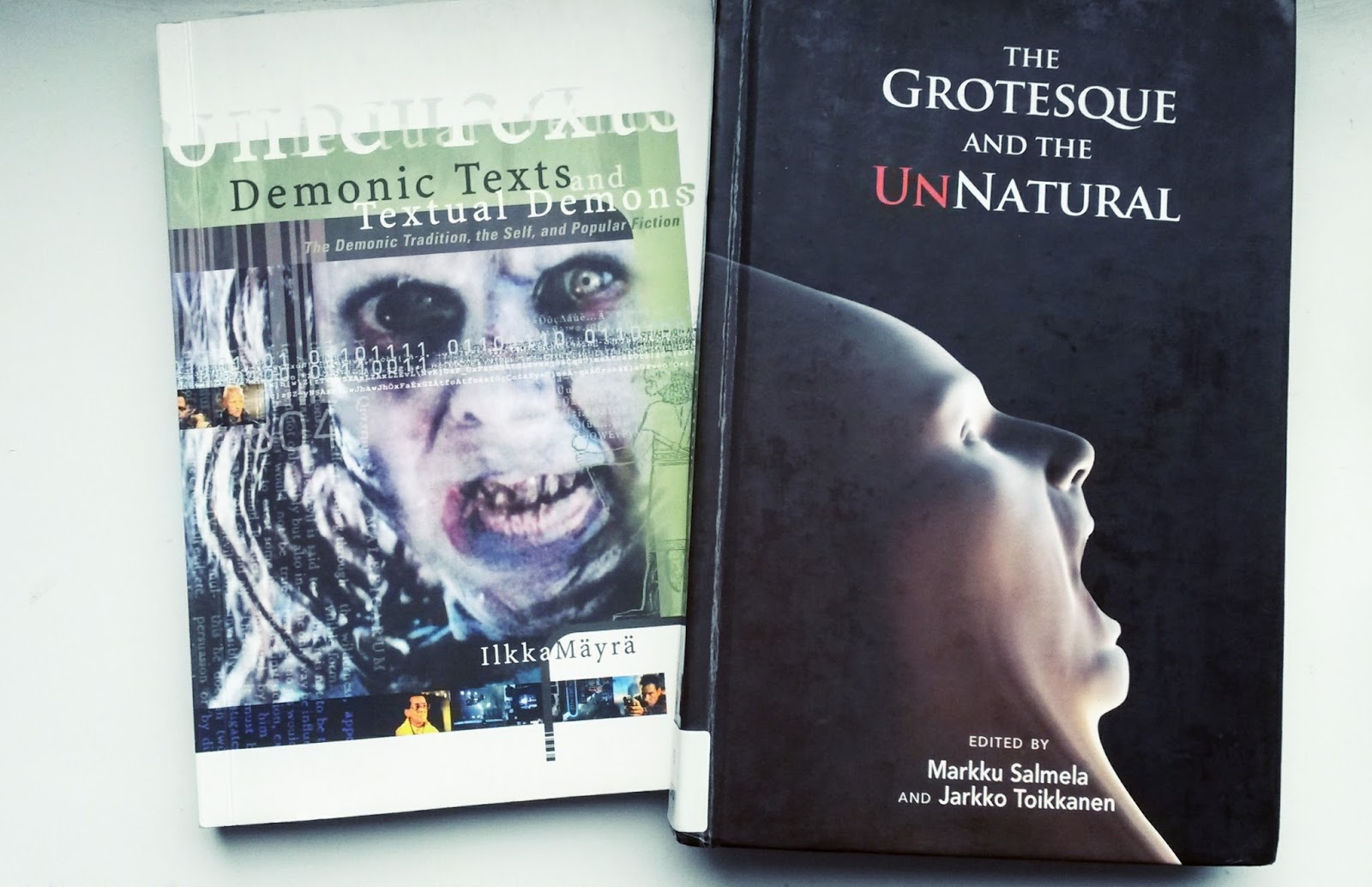
Creepy Reads Review: Textual demons and unnatural grotesqueness

Hello there!

I was not suppose to go a whole month without writing anything but unfortunately for the last month I've been extremely busy with my studies. So, I decided to feature two books I've been reading lately, that are related to my Master's Thesis. It's not as if I have any other life these days.

The other one of the books is the doctoral thesis of Ilkka Mäyrä named Demonic texts and textual demons: the demonic tradition, the self, and popular fiction (1999), and the other one is a collection of scientific papers, The grotesque and the unnatural (2011), edited by Markku Salmela and Jarkko Toikkanen.

As I've mentioned before, I am writing my thesis about grotesque in 21st century, in a French collection of short stories. In my thesis I construct a theory about what grotesque is nowadays and apply my hypothesis on the mentioned collection of short stories. Demonic texts and textual demons and The grotesque and the unnatural have been useful building blocks for me while I've pondered about the essence of contemporary grotesque.

The contributors of the collection of papers are researchers of literature and cultural studies who all find grotesque intriguing. Many of them emphasize how the way something is narrated or viewed creates the grotesque effect. This means that a human presence and participation is vital for something to be grotesque.

The papers of The grotesque and the unnatural are not purely about theory but instead many of them combine theories with analyses on novels or other products of culture and civilization. For instance, Mathilde Régent, who studied at Université Paris Diderot, contributed a paper about the grotesque in French medical discourse in the 16th century.

I of course have read this collection from the viewpoint of my own thesis but I believe for others too this could be an interesting read.

Ilkka Mäyrä's doctoral thesis is about demons in Western culture. It can be read online here, if my short introduction of it gets you interested.

In his thesis Mäyrä investigates what different roles demons have had and what things we consider demonic. He constructs theories and then applies them in case studies: among them The Exorcist and Ira Levin's novel Rosemary's baby. Mäyrä's work is both informative and entertaining. His writing flows easily and you do not have to be a literature student to understand it.

A great portion of Mäyrä's thesis is about how demonic features are linked to the self. He points out how in Ancient Greece people would explain the odd behavior of a human with daemons possessing him/her, and how in Freud's psychoanalysis the id (the unconscious part of the individual) has many demonic qualities. Needless to say that the way Mäyrä contemplates on the whole relation between "demon" and "human" has an essential role in my own thesis.

I can sincerely recommend both these books. I hope you too found this post of mine entertaining / interesting! :)

Short announcement: This spring will be very busy for me, I plan to finish my master's thesis in the beginning of May, so I shall be writing it 24/7 for the next two months. I do try to update my blog and read other people's blogs but I am not going to take any stress about it. Have a lovely March, and thank you for reading!

Sunday, 31 January 2016

Indigo: dystopic opera with a touch of metal music

Source
Yesterday I went to see an opera called Indigo, by two composers from the well known Finnish  metal band Apocalyptica. If you have not heard their music, I can strongly recommend it. They play metal with four cellos and they are amazing. Here is an interview (and a video clip of the opera!) in English, if you are interested to read more about the composers and the Opera.

This blog post is an analysis on the story and themes of this new metallic opera which was composed by Eicca Toppinen and Perttu Kivilaakso. I shall now warn you that this post contains spoilers, though with an opera that is not always a bad thing. Quite often one needs to have a significant amount of information about the plot in order to follow an opera performance. Partly because the tradition of opera just is so and the other reason is that often characters might sing their lines at the same time and actually hearing what they say is sometimes challenging. The synopsis with background information and the plot of the Indigo Opera can be found at the Finnish National Opera's webpage. The language of the Indigo Opera is English.

The situation where the story starts is that a corporation called CoOp Co has produced a drug to make people sleep less and hence be more productive. Alas, after 7 years the users get serious side effects, suffer and die. Everyone is eager to save them but the tests to find a cure are very dangerous. Last time they tried the test a scientist, who acted as the test subject, died. In this dangerous test the science team tries to get access to (and data from it) human's deepest level of subconscious, where the key to control sleep resides and that level is called Indigo.

In the Indigo Opera there are several parties who are interested in finding a cure: the company's scientists Daniel, his father, and Aurelia (in love with Daniel), the spokeswoman of the company, the widow of the scientist who died, and the Minister of Propaganda and his General, who represent the governments interests.


Indigo depicting the problems of moral

I think this opera problematizes moral and the relations of "reasons - deeds - results". The situation is severe, victims of the anti-sleep drug are furious and they are becoming an angry mob and the peace and security of the whole society is crumbling. Also the rioters themselves are in serious danger because of the drug. The first moral problem is, by what motives can different characters justify their wish  to continue those dangerous tests. And does it even matter? The Minister of Propaganda (the name gives quite the negative connotations, doesn't it?) only speaks about the health problems of the victims and how they are dying and how that must be stopped. But: he is characterized as a perv-y and pompous dude and you would imagine he is more concerned of keeping his position and maintaining the security of the society, not the victims. Still, he only acts as if he is on the victims' side, so is he morally more dubious than others if the goal and the deeds to reach it are the same? Only his own private reasons to act might be different.

Also the spokeswoman of the company says she wants to save the victims but one of the scientists, Daniel's father, is calling out her bluff while accusing her of the situation. He may have made the drug but the company decided to put it on market even though it was not safe. I think Indigo depicts how often there is no moral high ground to stand on and situations are seldom black-and-white.

I'm sure you all are familiar with the phrase "the ends justify the means" and I assume you know that a moral guideline like that is very problematic (an example: is it morally ok to euthanize every third citizen of a country in order to fight overpopulation? I believe the answer is no). This is the second moral problem: after considering what are the motives behind the wish to act on a problem, then how can one justify the actual actions aka. deeds? There is a pressure to perform that dangerous tests, that is very likely going to kill the human test subject. What means can justify an end like that and vice versa? Of course these two moral problems of motives and actions in relation to results are entangled and make the situation even more complicated.


Indigo depicting the hopelessness of humanity

It is argued, that the spokeswoman is only concerned of the company and it making money. This is proved to be true when Daniel's father confesses his guilt about making the drug and the angry mob kills him. The spokeswoman takes advantage of the situation, and makes the killed man her scapegoat. She storms to the scene with some assistants, blames everything on the dead man, promises to cure everyone (though there is no cure because the new test failed) and distributes some money to the masses. The mass of victims is fooled and they are happy and satisfied with some empty promises and petty money and the riots cease.

My opinion is, that this scene questions the future of humanity and what are our true values. For me the theme of Indigo is hopelessness. It also manifests how human interaction and real encounter between two humans is an illusion. This idea is extracted out of another significant part of the main plot, which is the love affair between Daniel and Aurelia, who both work at the company.

In the Opera, after some debate Daniel becomes the human test subject. He is plugged into a machine and he starts to drift towards the Indigo level of his subconscious. He ends up into a dream-like landscape and meets the previous test subject, who had died. The dead man claims that Daniel is inside his mind and that he controls everything in this other reality. Unfortunately, this reality can not contain two human minds and the previous test subject has to "leave" and it is implied this means he dies for good. The weird realm becomes Daniel's mind now.

Same time at the other reality it seems that Daniel has died during the test and that others did not get enough data of the process to make a cure for the victims of the drug. Situation is quite hopeless and people grieve Daniel's death. In the end of the Opera Aurelia decides to be the one last test subject in order to try to find Daniel and to get the much needed data for the cure. She is aware that she is sacrificing her life in this attempt.

Aurelia reaches the Indigo level and meets Daniel. Then follows a scene in which Aurelia and Daniel sing a very emotional song about how "they live forever in their love" which can only be seen ironically, since right after the song Daniel "must leave" like the previous test subject and Aurelia is left alone in the realm that now has turned into her mind. She is sorrowful for about 30 seconds but then she realizes how amazing, vast, and beautiful her own mind is and becomes almost deliriously happy in her own solitude.

The Opera ends, and there is no reassurance that the people in the reality got the data needed to make the cure and could save themselves. Quite hopeless, don't you agree?


Final conclusions 

The conventions of opera songs reinforces this ironic way to interpret the end of the Indigo, since opera is a genre in which great emotions and epic fates are shown by epic music: the more forcefully and knowingly something is expressed the flatter the actual emotions behind it become.

I liked Indigo very much and especially how it uses those conventions of opera and thus can comment on them. I loved that the grim situation of the characters did not get magically fixed but actually shows how Deus Ex Machina sort of plot twists and especially ways to save the characters are a mere illusion.

I hope you enjoyed reading this and please comment what do you think about opera, dystopias or the Indigo Opera if you've happened to see it!