Showing posts with label Finland. Show all posts

Friday, 14 April 2017

Peculiar Easter tradition of witches

In March, Goth Gardener announced a Baskets & Caskets competition. To participate, one needs to make a post according to the theme Goth Easter. Now, I don't believe this post fits the given topic but nevertheless Goth Gardener inspired me to write this post. :)

This post is once again about the odd traits of the Finns. Previously I've featured Nuuttipukki (the creepy Santa Claus) and fortunetelling traditions.

On Easter, we have a tradition that is very similar to the trick-or-treating on Halloween. It's called 'virpominen'. In short, children dress as witches or Easter bunnies and go around the neighborhood in order to get candy. BUT: they are not like evil spirits on Halloween who threat people with tricks.

Instead it is more like a mutually beneficial transaction. The kids collect and decorate sticks of pussy willow and will use them to cast spells of good luck for the neighbors. After the spell the kids will give the decorated willow to the neighbor and as a payment the kids will receive some candy.

Since I was super fascinated by witches as a kid (and still am), I was as excited about Easter as I was about Christmas. I could dress as a witch myself, it was like heaven! To clarify my behavior, I want to point out that during my childhood Halloween was not a big thing (it is still a very minor holiday here in Finland).

Here is a photo from my childhood. Since Finland is so up North, we used to have winter weather on Easter (at least during the 90's, with the climate change it is sort of a spring nowadays). So, us kids used to have to dress our witch garments over our winter coats. Nevertheless, it was always super fun!

In the photo you'll see the most fashionable gear an Easter witch could have: a black paper board hat and a broom. The broom was made by my father and I had tied some scarfs around my waist to get the proper witch look. The witch's familiar is also appearing in the photo (aka my pet dog).

The traditions behind virpominen


This tradition has roots both in the Orthodox traditions and in the old customs Finns had before Christianity arrived. I am not an expert on these traditions and beliefs, but here is how I've understood the historical roots of this tradition.

Pussy willows are not just a Finnish thing, in Eastern European countries many people use pussy willow in their rites on Palm Sunday. Palms do not grow here in the North, so people needed to substitute them with some other plant. I'm not sure if this is something people still do, but in the old days a priest blessed the willow sticks and then children took them home, decorated them, and then used the willows to bless their immediate family.
Willows made by the kids next door.
There is also another Christian belief related to virpominen. In the Nordic countries, people believed that during the days between the Good Friday and Easter Sunday the protecting powers of God were, well, diminished. Therefore people believed that evil witches were roaming around the countryside and causing misfortune to people. To prevent this, people did all sorts of protection spells that resemble the idea behind virpominen.

So, that was the Christian part of the tradition of virpominen. I am guessing that the pagan roots of the Finns twisted it a bit and that is why the kids dress as witches for it. In the old times, witches, witch doctors and shamans were appreciated members of the community. I guess that's why there are also good witches who now cast spells of good luck.

I've not heard that other countries would have this tradition of virpominen. If you have, please comment on this post!

I hope you enjoyed this little piece of information and do check out what people contributed to Goth Gardener's competition!

Tuesday, 27 December 2016

A Finnish New Year's Eve Tradition

In the end of last year, I entertained you with a post about a rather grim tradition that the Nordic countries used to have close to Christmas time: Nuuttipukki. Now I am going to write about a tradition that is still alive and kicking, and is performed on the New Year's Eve.

The tradition is called a New Year's Tin and it is a way to try to predict the future. Finns have been doing this since the 18th century at least, but this form of fortunetelling was already known in the Ancient Rome. Nowadays it is harmless fun that people in the Nordic countries do. This custom is also known in Germany and in Austria.

What you need

  • Tins shaped like a tiny horse shoe (it's actually a concoction of tin and lead to get a lower melting point, and the horse shoe signifies good luck). The diameter of a horse shoe is about 4 cm (1,6 inches) long.
  • A scoop designed for this thing
  • A stove or a fireplace
  • A bucket filled with cool water
  • A candle or a flashlight (optional, any good source of light will do)
Notice: Some induction stoves do not recognise such a small scoop and for that reason I am going to demonstrate this tradition with a fireplace. Remember always to be extra careful when you are close to an open fire!

How to do it


Put the tin into a small scoop. Then put the scoop on a hot stove or to the hot fireplace until the tin is melted.

Then, you flip the melted tin into the water bucket. The water level needs to be deep enough so that the tin has time to freeze into a shape before it hits the bottom of the bucket! Otherwise you all get a pancake shaped future.
Every participant has her/his own tin. The one whose future is about to be told must be the one who flips the melted tin into the water.

Pick the tin from the water and now you are ready to find out what the coming year will bring to you!
You examine both the tin and the shadow it casts. This is what you might need the candle or a flashlight for: you hold your tin close to a wall and point a flashlight to it. Then you can examine the shadow more easily.
That's not my hand, btw. It's my lovely assistant (read: a close relative).
We photographed these when I was visiting my family on Christmas.
This is a bit like trying to understand one's dreams: things symbolise different stuff for different people. Still, here are some traditional interpretations:
  • A ship or a plane means a travel.
  • A bird is a sign of good luck.
  • A crown or a key means success in your work.
  • A ring will mean a wedding (not yours, necessarily).
  • If the tin broke down into several small pieces, you'll be having a troublesome year.
  • If there are blackened parts on the tin, it means bad luck and/or sorrows.
  • If there is a lot of "scruffiness" in it, it means you'll get a lot of money.
The "scruffiness" is that not so shiny part on the upper part of the tin. I do not know what to call it. :) As you can see from the previous photo, this tin's shadow looks a bit like a wolf. I have no idea how to interpret that. But that doesn't really matter, because this tin was not made on a New Year's Eve, so it's not valid for predicting the future.


Happy New Year, everyone!

Tuesday, 2 August 2016

Creepy and geeky art treasures at the Serlachius museums

As I promised in my previous post, I am going to continue writing about my art road trip. After the city of Tampere and Ron Mueck's installations our next stop was at Mänttä-Vilppula, the city of art as they are called. This nickname came because a very influential family Serlachius lived in Mänttä-Vilppula and the members of this family loved art, especially a man called Gösta. The Gösta Serlachius Fine Arts Foundation was created and the artworks they've acquired are displayed in Serlachius museums at the city of Mänttä-Vilppula.

Art Museum Gösta


The art museum is named after Gösta. They have a new extension to it, Gösta's Pavilion and in there they feature contemporary art. This summer they have a big exhibition of Mark Wallinger's works, open until 9th of October 2016. Wallinger is a painter, sculptor and a video artist. His works, materials and style varies a lot.

This are from the series of id Paintings. The inspiration came from Sigmund Freud's theories and the concept of id and I presume also from the idea of subconscious. They look like huge versions of the Rorschach test. They are taller than an average human, and in the exhibition room there were about 20 of those paintings. It made a person feel really small.

The Rorschach test is a test based on association and interpretation. The patient (or a person examined) looks at cards with ink spots and tells what she/he thinks they look like or symbolize. These interpretations are then seen as sort of messages from the persons subconscious and from them others can try to judge if this person is having stress or for example mental problems.

I would like to note that I have not studied psychology and that short explanation is a simplified and possibly quite crude way to describe the Rorschach test. I personally think that doing/playing this sort of an association game can be fruitful but people really should pay attention to the fact that humans do not share all symbols: for someone a butterfly is a joyful thing, for another one it symbolizes fragility.

It was actually quite fun to start to really look at these paintings and try to analyze and imagine what all those shapes formed. In this painting I saw two mountain hares hanging from something. Possibly they are today's catch and someone is about to make dinner of them. What do you see in this painting?

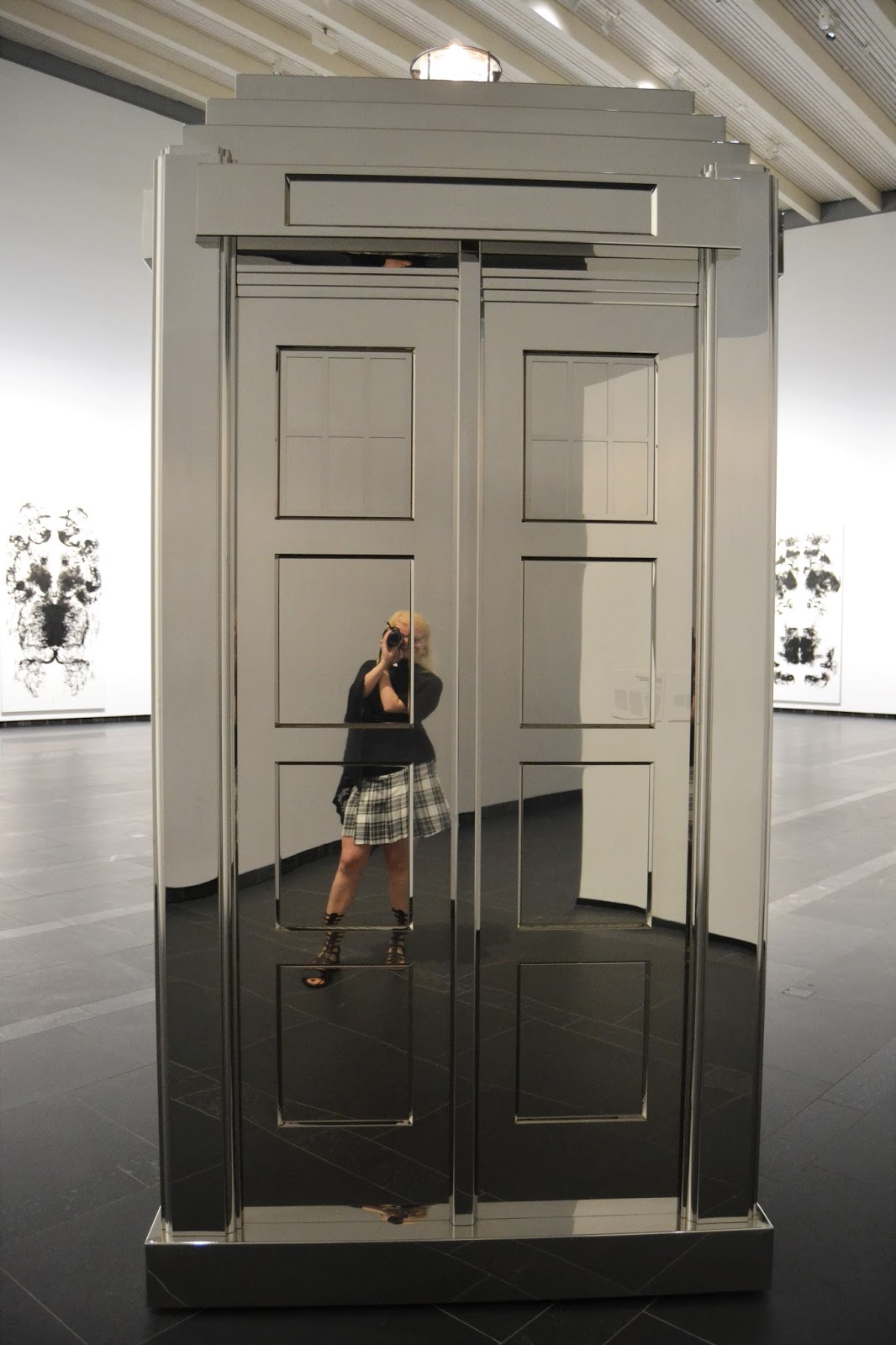
The id Paintings were made 2015. This sculpture named Time And Relative Dimensions In Space is from year 2001.
As I mentioned in the previous post, there was something that reminded me of Doctor Who. If you picture this shiny box to be blue and have the words Police Public Call Box on it, you'll understand.

Here is me next to it for measurement. Its outer dimensions (aka size) are almost exactly the same as Tardis has. They might even be the same, alas I have never seen Tardis or the props they have for the TV show.
I did not touch it because I am a law abiding art museum visitor and it was highly prohibited. Wanted to, though.

Museum Gustaf


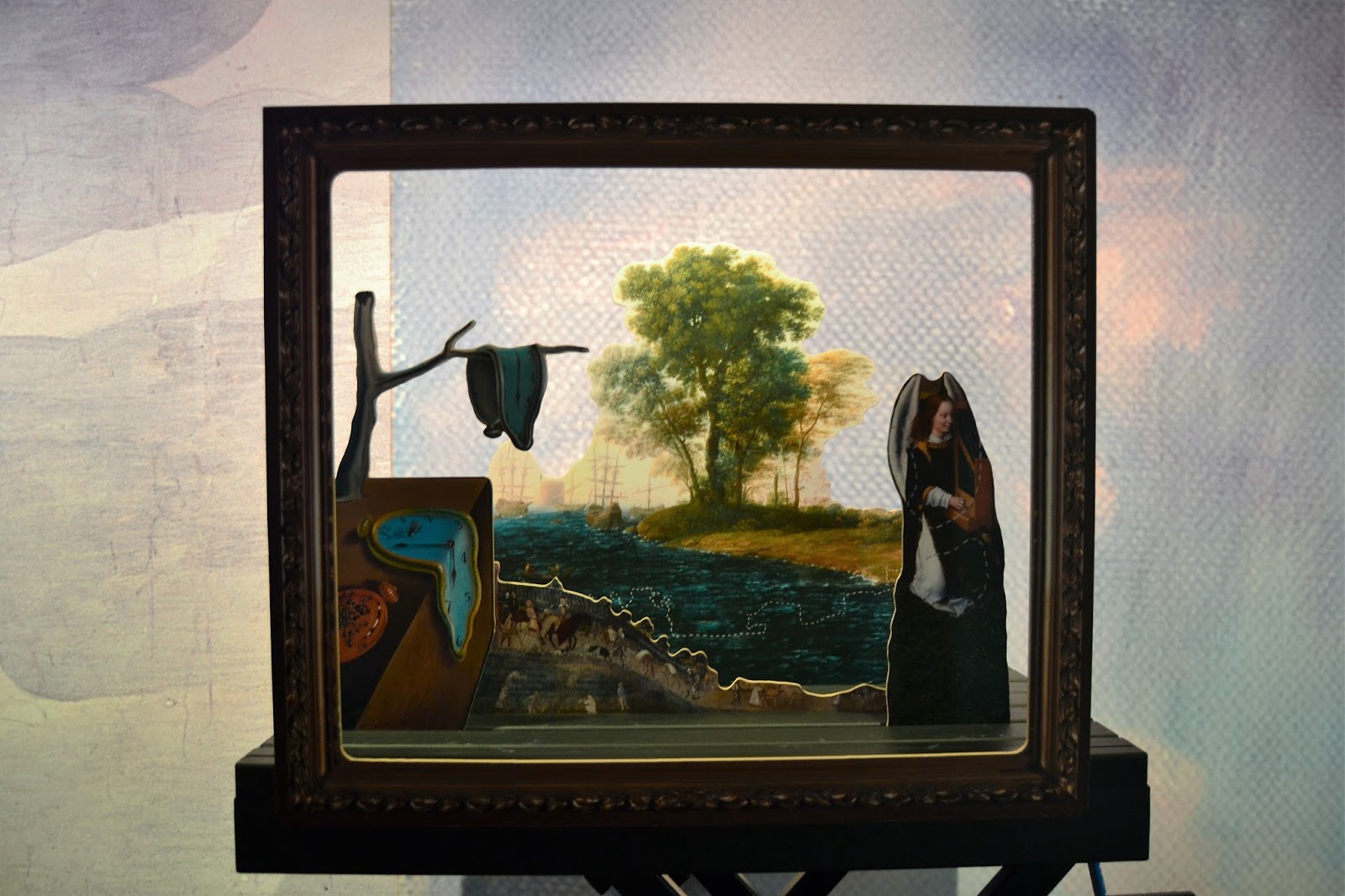
Those were some works at the Gösta Art Museum. In Mänttä-Vilppula there is another Serlachius Museum named Gustaf. They usually have exhibitions about history and technology but this summer they also had an exhibition called Landscape. It was an interactive exhibition in which people could learn about the history of landscape art, and create their own landscapes of the pieces of famous landscape paintings.
From the photo above you can see the entrance. Maisema means landscape and on the right there are pieces of famous paintings. Inside the room there were sort of tables with frames. On the other wall there were replicas of famous paintings, the pieces of paintings for constructing one's own landscape (in the shelves), and video screens. The videos were about landscape paintings and their history.
Here are two installations I made. The other one is with Dalí's watches and a random angel.
And the other one is a mix of some winter paintings. A more classy combination, I'd say. Do click the images for a larger view and better details. I took these photos with a real camera, not my phone, so the quality is not that devastatingly bad.
I hope you enjoyed this post. I had fun at the museums and fun writing about them, and I do hope some of that happiness and enjoyment shines through this post.

Next time: cute and macabre art from the next destination on my road trip!

Tuesday, 26 July 2016

Gothic Art in Spotlight: Uncanny Giants of Ron Mueck

Last weekend I went for an art road trip in a small but selected company. This means that we left the capital of Finland and traveled through ten art museums and other summer exhibitions during three days.

The route took us from Southern Finland to West, the city of Tampere, and then to Eastern Finland. You can roughly see the route here in this map in purple, it's unimaginatively named as 'Art Road Trip'. The distance me and my entourage traveled was about 600 km (370 miles).
Map made with karttaikkuna.fi
The places we visited on Friday were:

Riihimäki art museum
Hämeenlinna art museum (Riihimäki and Hämeenlinna are the names of different cities)
Sara Hildén Art Museum

Sara Hildén (1905–1993) was a Finnish businesswoman and a patron of arts. She started an art foundation (named after her) in 1962. The foundation concentrated on modern art but they do hold exhibitions of contemporary art these days. This summer they are hosting a solo exhibition of Ron Mueck. Previously they've had solo exhibitions of many famous artists, among them Andy Warhol.
Mueck is an Australian artist, and has made only 40 works. 10 of them are displayed this summer at Sara Hildén Art Museum in the city of Tampere. The works are extremely life-like sculptures that are in some way out of proportion. They are either outrageously large and hence uncanny or very small. 

I found the exceptionally large works delightfully disturbing. among them were a giant couple under a parasol, a human-sized dead chicken and a baby the size of a whale. 
The sculptures are detailed, they have individual hairs and pores and everything. This might be a weird thing to say, but the sense of 'flesh' was very strong in the exhibition. 
Unashamed I used random people as measuring sticks for these art works. The sculptures would not look so exceptional, if you could not understand the size of them. I think this gigantic baby is fascinating and at the same time repelling. 

What do you think of Ron Mueck's art?

Next week: the treasures of Serlachius Museums, among them something that will probably remind you of Doctor Who!

Tuesday, 22 December 2015

A Scary Christmas Legend: Nuuttipukki from the North

Happy Holidays!

Since it is the season of Merry, I wish to share with you an old  and perhaps a bit sinister folklore story related to Christmas. Most of you are probably aware of the legend of Krampus, since an American horror/comedy movie came out this year with that same name. Really shortly said, Krampus is a mythological creature from the Alps, who is a sort of an Anti-Santa Claus. While Santa rewards nice people, Krampus punishes the bad ones. This post is about a whole other entity from the Nordic countries. This tradition spread from Sweden to Finland centuries ago, probably in the Middle Ages.

The spooky creature I am going to write about is called Nuuttipukki (it is translated as the New Year Buck in some sources), who is a horned, goat-like humanoid with an entourage of masked folk and he visits houses during the Saint Knut's Day. It used to be on January 7 but nowadays Saint Knut's Day is celebrated a week later. The tradition of Nuuttipukki still remained on the first week of the new year, though.

Nuuttipukki and his friends roam around the village and go from house to house insisting to have leftover foods and alcohol beverages after Christmas. It is bad luck not to yield to his requests, otherwise he might scare your animals, trash your garden and harass your servants (and he might still do that after food and drink, you never know with Nuuttipukki).

I wish to stress that this was not something that happened on the level of stories but in the reality too and it was not the master of the house who organized it. It was usually young men from another village who dressed as Nuuttipukki and his fellows and they might be quite drunk and mischievous. You could not be completely certain that food and booze would keep them happy.

This tradition was alive and kicking in Finland until the Second World War. Here is a photo from 1926. I believe the broom in this photo is part of the costume, to make this person more goat-like, so it is not a witch thing.
Source
The blackmailing (that resembles trick or treating) was not the only reason for people to let this creature and his companions to the house. The other reason people were willing to let these rascals in was that Nuuttipukki was supposed to scare off the spirits of the dead before they became evil possessing spirits. It was believed that Christmas and its celebrations lured the spirits of dead relatives back to this world. This is the oldest reason for this carnivalistic celebration: the masks were to hide who was the one scaring the dead away so that the dead could not have their revenge on this person or persons.

Here is a photo of a mask of Nuuttipukki from the 19th century Finland. It is made out of sheepskin. This mask is from the collection of the National Museum of Finland and the photo was taken by Markku Haverinen.
Source
Interestingly, Nuuttipukki is an older character than Santa Claus in Finland and the character of Santa resembled Nuuttipukki until the 1940's. Imagine Santa with a face like that! Even more, in Finnish language Santa is called "Joulupukki", so it is a very similar word with "Nuuttipukki".

As mentioned previously, it was believed that the dead Finns like the Christmas and in today's Finland it is still customary to commemorate the deceased relatives on Christmas. We take candles on the graves and on Christmas Eve the graveyards are astonishingly beautiful seas of candlelight. We also bring candles on the graveyards on All Saint's Day (about the same time as Halloween) to commemorate the dead and on 6th of December, which is our Independence Day, to commemorate the dead and especially those who died in the wars in which Finland fought to keep its independence. As you can see, the Finns are very respectable towards the dead.
Source
Thanks for reading, I hope you found this interesting and entertaining!