Tuesday, 2 August 2016

Creepy and geeky art treasures at the Serlachius museums

As I promised in my previous post, I am going to continue writing about my art road trip. After the city of Tampere and Ron Mueck's installations our next stop was at Mänttä-Vilppula, the city of art as they are called. This nickname came because a very influential family Serlachius lived in Mänttä-Vilppula and the members of this family loved art, especially a man called Gösta. The Gösta Serlachius Fine Arts Foundation was created and the artworks they've acquired are displayed in Serlachius museums at the city of Mänttä-Vilppula.

Art Museum Gösta


The art museum is named after Gösta. They have a new extension to it, Gösta's Pavilion and in there they feature contemporary art. This summer they have a big exhibition of Mark Wallinger's works, open until 9th of October 2016. Wallinger is a painter, sculptor and a video artist. His works, materials and style varies a lot.

This are from the series of id Paintings. The inspiration came from Sigmund Freud's theories and the concept of id and I presume also from the idea of subconscious. They look like huge versions of the Rorschach test. They are taller than an average human, and in the exhibition room there were about 20 of those paintings. It made a person feel really small.

The Rorschach test is a test based on association and interpretation. The patient (or a person examined) looks at cards with ink spots and tells what she/he thinks they look like or symbolize. These interpretations are then seen as sort of messages from the persons subconscious and from them others can try to judge if this person is having stress or for example mental problems.

I would like to note that I have not studied psychology and that short explanation is a simplified and possibly quite crude way to describe the Rorschach test. I personally think that doing/playing this sort of an association game can be fruitful but people really should pay attention to the fact that humans do not share all symbols: for someone a butterfly is a joyful thing, for another one it symbolizes fragility.

It was actually quite fun to start to really look at these paintings and try to analyze and imagine what all those shapes formed. In this painting I saw two mountain hares hanging from something. Possibly they are today's catch and someone is about to make dinner of them. What do you see in this painting?

The id Paintings were made 2015. This sculpture named Time And Relative Dimensions In Space is from year 2001.
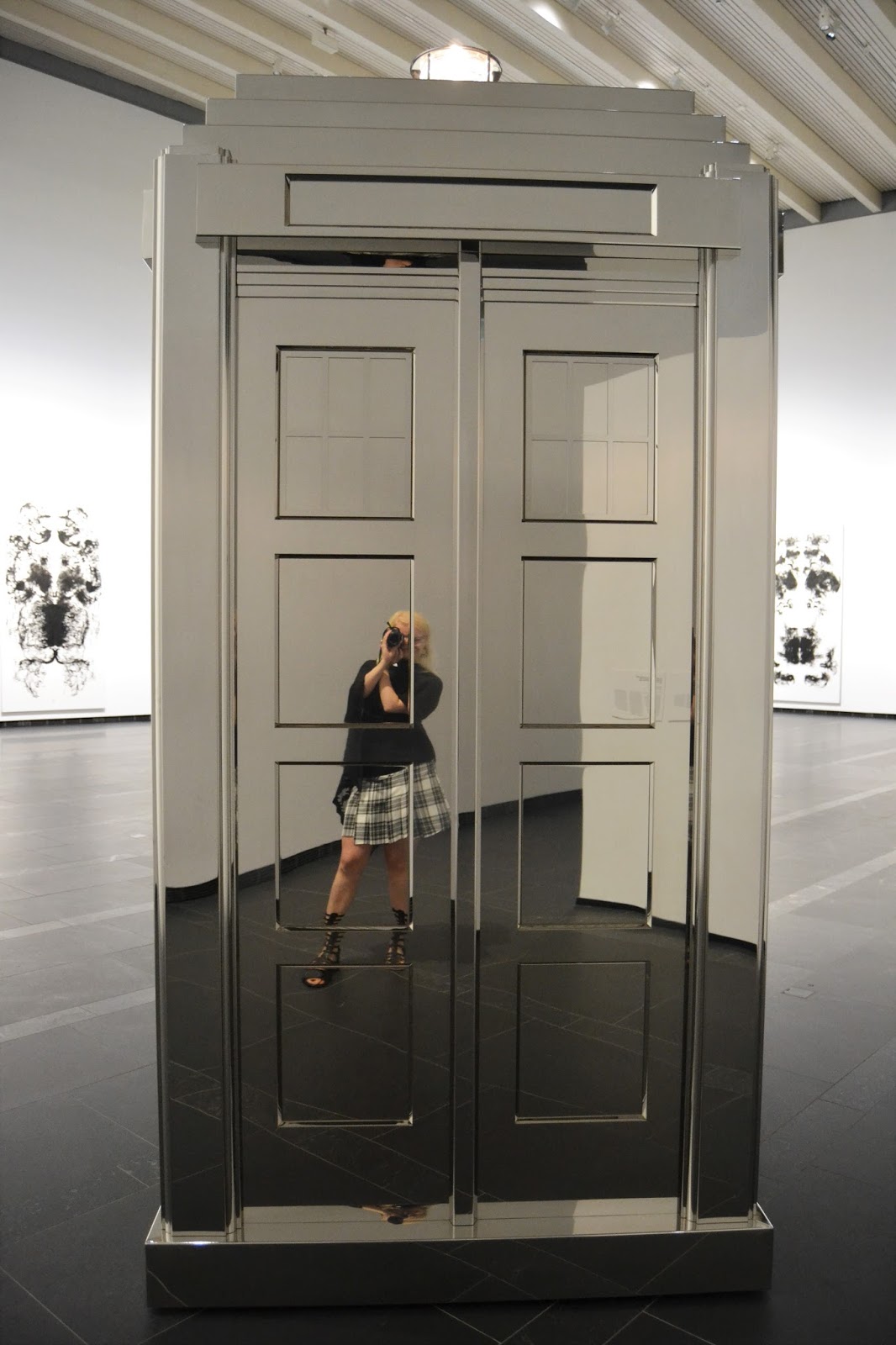
As I mentioned in the previous post, there was something that reminded me of Doctor Who. If you picture this shiny box to be blue and have the words Police Public Call Box on it, you'll understand.

Here is me next to it for measurement. Its outer dimensions (aka size) are almost exactly the same as Tardis has. They might even be the same, alas I have never seen Tardis or the props they have for the TV show.
I did not touch it because I am a law abiding art museum visitor and it was highly prohibited. Wanted to, though.

Museum Gustaf


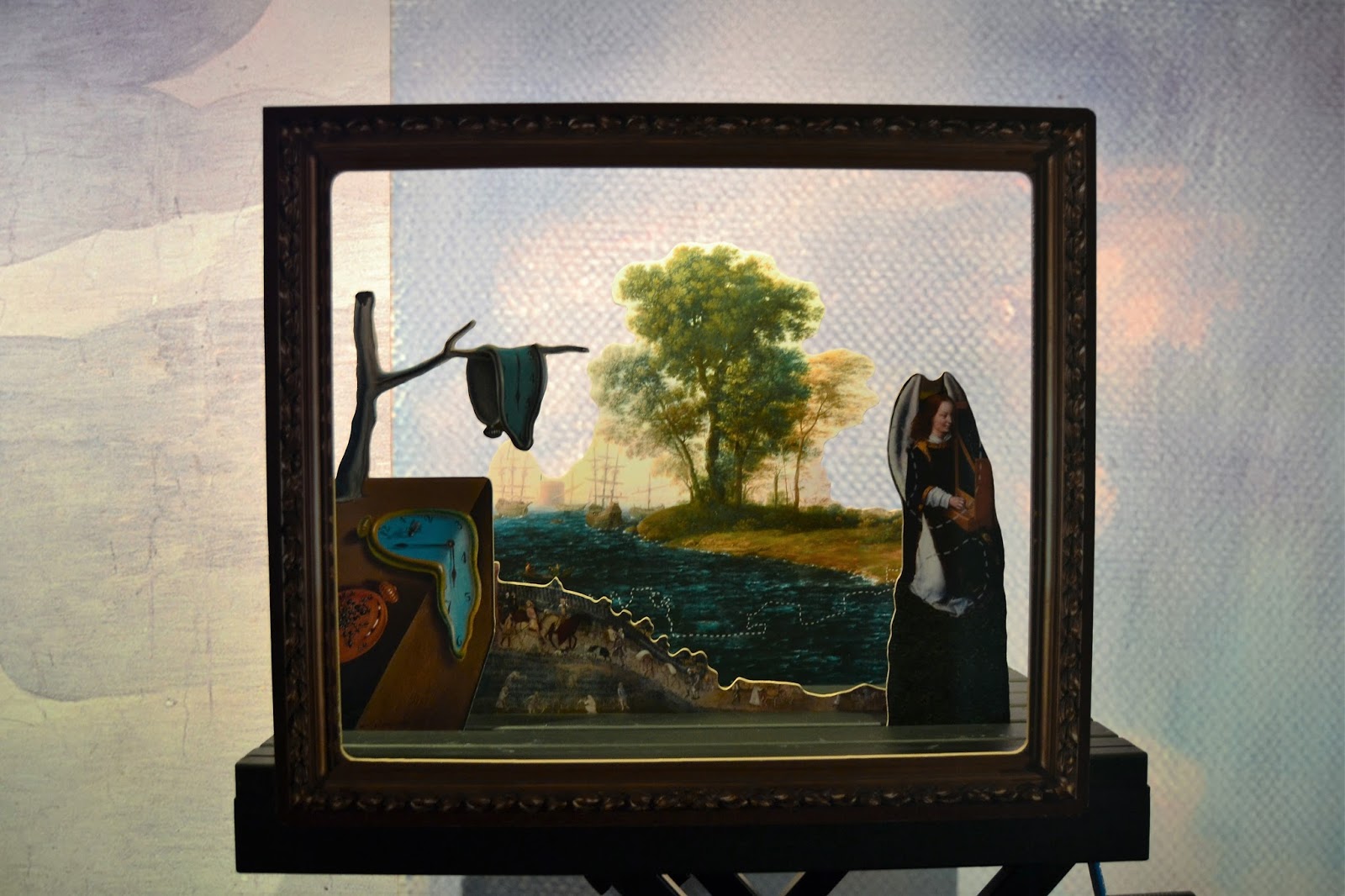
Those were some works at the Gösta Art Museum. In Mänttä-Vilppula there is another Serlachius Museum named Gustaf. They usually have exhibitions about history and technology but this summer they also had an exhibition called Landscape. It was an interactive exhibition in which people could learn about the history of landscape art, and create their own landscapes of the pieces of famous landscape paintings.
From the photo above you can see the entrance. Maisema means landscape and on the right there are pieces of famous paintings. Inside the room there were sort of tables with frames. On the other wall there were replicas of famous paintings, the pieces of paintings for constructing one's own landscape (in the shelves), and video screens. The videos were about landscape paintings and their history.
Here are two installations I made. The other one is with Dalí's watches and a random angel.
And the other one is a mix of some winter paintings. A more classy combination, I'd say. Do click the images for a larger view and better details. I took these photos with a real camera, not my phone, so the quality is not that devastatingly bad.
I hope you enjoyed this post. I had fun at the museums and fun writing about them, and I do hope some of that happiness and enjoyment shines through this post.

Next time: cute and macabre art from the next destination on my road trip!

Tuesday, 26 July 2016

Gothic Art in Spotlight: Uncanny Giants of Ron Mueck

Last weekend I went for an art road trip in a small but selected company. This means that we left the capital of Finland and traveled through ten art museums and other summer exhibitions during three days.

The route took us from Southern Finland to West, the city of Tampere, and then to Eastern Finland. You can roughly see the route here in this map in purple, it's unimaginatively named as 'Art Road Trip'. The distance me and my entourage traveled was about 600 km (370 miles).
Map made with karttaikkuna.fi
The places we visited on Friday were:

Riihimäki art museum
Hämeenlinna art museum (Riihimäki and Hämeenlinna are the names of different cities)
Sara Hildén Art Museum

Sara Hildén (1905–1993) was a Finnish businesswoman and a patron of arts. She started an art foundation (named after her) in 1962. The foundation concentrated on modern art but they do hold exhibitions of contemporary art these days. This summer they are hosting a solo exhibition of Ron Mueck. Previously they've had solo exhibitions of many famous artists, among them Andy Warhol.
Mueck is an Australian artist, and has made only 40 works. 10 of them are displayed this summer at Sara Hildén Art Museum in the city of Tampere. The works are extremely life-like sculptures that are in some way out of proportion. They are either outrageously large and hence uncanny or very small. 

I found the exceptionally large works delightfully disturbing. among them were a giant couple under a parasol, a human-sized dead chicken and a baby the size of a whale. 
The sculptures are detailed, they have individual hairs and pores and everything. This might be a weird thing to say, but the sense of 'flesh' was very strong in the exhibition. 
Unashamed I used random people as measuring sticks for these art works. The sculptures would not look so exceptional, if you could not understand the size of them. I think this gigantic baby is fascinating and at the same time repelling. 

What do you think of Ron Mueck's art?

Next week: the treasures of Serlachius Museums, among them something that will probably remind you of Doctor Who!

Tuesday, 12 July 2016

Gothic Art in Spotlight: The everyday cruelty in Jarmo Mäkilä's art

Some time ago I went to see the art exhibitions at HAM, Helsinki Art Museum. There were a couple of big exhibitions and a couple of small exhibitions in their facilities. The exhibition that made my little goth heart shiver the most was the exhibition From Heino With Love. Heino is the surname of a family that began to collect contemporary art. Their love for art gave birth to the Heino Art Foundation. This exhibition in HAM is the first time the public can see a glimpse of their extensive collection. The exhibition is on until 28th of August 2016.

Bleak and cruel childhood


The exhibition From Heino With Love featured many interesting contemporary artists but what really caught my eye on my visit to the museum were the works of Jarmo Mäkilä. His works often show the mundane cruelty of our everyday life. Mäkilä has made sculptures, paintings and installations. Many of his work have a sort of a horror film atmosphere, but some are terrible in a more documentary sort of way.

The piece I want to show you is named First Day at School (2007–2008). It is an installation of a miniature model of a school building. On the other side there is either a trail of toys leading to the school, or quite possibly escaping from there.
On the other side the building there are visible marks of violence. The windows are smashed and there are signs of a fire or an explosion.
For me this is a bleak description of a child's feelings when he/she is forced to go to a scary new facility for the very first time. Very big schools with not enough staff and too many bullies can seem like a hostile place to be.

What thoughts spring into your minds?

Art around the city


What I really like about HAM is that they also organize exhibitions outside the museum. At the moment one of the old boulevards for pedestrians in the center of Helsinki is the showplace for an installation by one of the best known contemporary artists: Japanese Yayoi Kusama.
Kusama has wrapped the trees into polka dots. The whole street looks like this. A bit like Wonderland, isn't it?

HAM also has an exhibition room or a window in the nearest metro station (simply named as HAM metro). It is a sort of a glass cage for the art on the platform so people waiting for the next metro can look at some art while they are on the platform.
At the moment HAM features large paintings by a Swedish graffiti artist Kaos.

I hope you enjoyed this post!

Tuesday, 28 June 2016

Creepy Reads Review: The Graveyard Book by Neil Gaiman

I recently read a novel by Neil Gaiman and wanted to feature it here in the blog. The name of that novel is The Graveyard Book. It tells the story of a little orphan boy who ends up in the graveyard and the ghosts raise him up, with some help from another person or creature living in the graveyard. I really liked that the narrator never actually says what this guardian type of character is. It is implied that he has many traits of a vampire, though.
The Finnish translation's cover
The world of this novel has supernatural and fantasy elements straight in the beginning. As is typical for the novels and graphic novels of Gaiman, around the fantasy elements there looms the normal magic free reality, but none of the main characters belong strictly to the normal world. I liked this book and want to encourage others to read it too, so I try my best to avoid spoilers.

The story begins with a scene in which a man named "Jack" kills a family, but their toddler manages to escape to the graveyard close by. The toddler is found and rescued by ghosts. He does not speak yet and hence has no name. The ghosts decide to call him Nobody. It is clear that the toddler is very important for some reason. The story of the boy Nobody and his family opens up slowly during the novel. Strong themes in this novel are loneliness and personal growth.

The Graveyard Book is categorized as a fantasy novel for children. I agree that children and teenagers are clearly the target audience, which is a slightly younger audience than what many other novels by Gaiman have. As an example I could mention Neil Gaiman's graphic novel series The Sandman and the novel Anansi Boys. It's been years since I read that one, but I have this faint memory that if considering ethics and who is evil and who is not, Anansi Boys was a lot more 'gray area' than The Graveyard Book. Which is great like that, since in Anansi Boys the characters are adults but in The Graveyard Book the main character is a boy growing up from being a helpless toddler to a youngster. The narration kind of leans towards the cognitive skills of a young boy, without being infantile.

The illustrations in this Gaiman's novel are made my Dave McKean, who has illustrated many other goth-y stories and books too. One featured before in this blog is The homecoming by Ray Bradbury. If you check that post out, you'll notice that in The homecoming the illustrations are more tightly knitted to the text than in The Graveyard Book.

I really liked The Graveyard Book. The plot structure was a mix of a growth story and a swashbuckler or an adventure story. They are both rather predictable plot structures but the novel was still very enjoyable and did not use any really stereotypical cliches. Strongly recommend!

Thursday, 9 June 2016

Gothic Art in Spotlight: The Black Paintings of Goya and a trip to Madrid

I spent the last full week of May in Madrid, as a sort of a summer holiday because I am going to be working the whole summer (of which I am glad!). In my previous blog post I already mentioned that this spring would be very busy for me and I was not wrong. I have finished my studies and before I traveled to Madrid, the capital of Spain, I had emptied and cleaned my apartment in Tampere, the city where my (soon to be ex-)University is. I returned from Madrid  two days before my new work began and for the past week I've been still very busy, learning the new job.
The view from the hotel room in Madrid
In Madrid I visited many amazing art museums and saw many great paintings and statues by famous and not so famous artists. The works were beautiful or thought-provoking but not something that was hitting that "goth spot", if you know what I mean. :) The most goth paintings I saw on my trip would be Francisco de Goya's "Black Paintings". I saw most of them at the Museo del Prado, the distinguished art museum with the largest collections in Madrid. They had a whole room full of Goya's grim and ominous paintings.

The Black Paintings are paintings Goya (1746–1828) made between 1819 and 1823. He used much darker colors and shades compared to his earlier works and most importantly, the paintings depicted sinister and horrifying things. This is a painting called "Saturn eating his son" and the name is quite explicit. Saturn, the father of Zeus and other gods of Ancient Greece, is devouring his own son because there was a prophecy that one of Saturn's own children would kill him. So he would eat them all. This is a striking and obscene painting.
Source
I must admit that I've never been a fan of Goya and the Black Paintings do not make my heart shiver nor do they put me into awe. The subjects of the Black Paintings are interesting but something in Goya's style just isn't suitable for me. Goya also made some paintings of witches and their grim rites in the end of the 18th century. Their colors are lighter but subjects are not. In this painting a group of witches are having a feast with the incarnation of the devil or another demon and they are offering dead or ghoulish children to him. Or at least that is how I interpret this scene.
Source
These paintings could easily delight and interest goths. The macabre and twisted elements are fairly visible and they have a sort of a timeless vibe in them, with the mythical themes and folklore-ish subjects.

As a side note: Museo del Prado is now having an exhibition of Hieronymous Bosch and his works and it looks like it is amazing. Alas, I could not see it because I had to return to Finland before the exhibition opened. The exhibition is the biggest exhibition of Bosch this year. If you happen to be in Madrid in near future, that Bosch exhibition is definitely worth checking out!

Saturday, 30 April 2016

Personal update and some uncanny art

Once again a month has passed by. I have been working on my thesis relentlessly and I am happy to say that in two weeks it shall be finished and I will graduate this semester! That will mean that I have more time to write this blog. ^__^ Another thing that has been preoccupying my free time for the past couple of months is the search for an apartment. In the beginning of June I start working in a different city and need to find a place to live. I am really excited because a new chapter is beginning in my life.

For the past couple of months I have visited several art exhibitions but they have not often suited the themes of this blog a.k.a. the artworks I've seen have not been extremely "goth" nor have they represented darker aesthetics. This installation is something I would like to feature. I think it is rather uncanny.

This installation was made by Finnish artist Mia Hamari. Another work of hers was featured in this post in January. The name of this work is "Manual, Siberia, Jester, Party". It is made of two figures. A more human-like creature and an animal with a human face. Hamari draws inspiration from dreams and the subconscious. Her works often feature a human-animal metamorphosis. In this work there are also mechanical/clockwork aspects to them, since the other one has wheels instead of back limbs.
This work was exhibited at the Gallen-Kallela Museum. Gallen-Kallela is one of our national artists and the museum is his old home turned into an exhibition place. There are changing exhibitions and this work of Mia Hamari can be seen till the end of May 2016.
As you can see, this artwork is made of mixed materials, among them bronze, wood and parts of animals. The animals Hamari uses in her art have died in accidents. She has also used human parts like hair and eyelashes. Presumably they are of her own or donated to her.
This smaller statue is the size of a small terrier or another dog. What I really like about this installation is that the expressions on both the creatures' faces are a bit ambiguous, one can easily interpret several different feelings. This way the work can express different feelings and atmospheres, depending of the viewer. The small one is looking up and the taller one has closed its eyes. Though the small one has no pupils in its eyes so nobody knows if it can even see. Very uncanny.

I hope you liked this installation of Mia Hamari!

Sunday, 27 March 2016

Review: Macabre card game Gloom

Today I would like to feature a card game suitable for goths and other darkly inclined. The game is called Gloom and it is designed by Keith Baker.
This game of "inauspicious incidents and grave consequences" is hilarious and twisted. Each player has a family they play as and the goal is to make one's own family members as miserable as possible and eventually cause their untimely deaths.

Here are my three favorite characters from two different families The murderous matriarch Old Dam, Cousin Mordecai ("Inbreeding is the least of his problems"), and Professor Helena Slogar, who "enjoys gardening, long walks in the moonlight, and reanimating the dead". I love the sinister humor of this game! As you can observe, the cards are transparent plastic. The family is placed in front of the player and cards are played on them.
During the game players can play life events (called Modifier cards), which can be either good or bad, on the characters. Then there are of course the "Untimely Death" cards which are played on characters too. The third playable card is called "Event" which is a card that is happening on the meta level of the game: it is not played on a character but for example with it the player can remove all Modifier cards from a chosen character or to stop another player from playing an Untimely Death.

The game ends when somebody's family is completely wiped out. Then the "Self-Worth Points" of all dead characters are counted and who ever has the most points wins. Here are some Modifiers with various Self-Worth points:
Half the fun is to tell a story as one plays the Modifiers on characters. In this following scenario on the character of Professor Helena Slogar is played a Modifier "Was mauled by a manatee" and then "Was swindled by salesmen". It will be much more fun if one tells these misfortunes in a form of a short story:
"Professor Helena Slogar was starting a new research project with aquatic mammals. She had started to test if she could infect a manatee with rabies. The tests showed positive outcomes and Professor Helena was very excited. So excited, that she became careless and while feeding the rabies ridden manatee she fell into its tank! Alas, she was mauled by the manatee."
"Bloody and torn she finally managed to climb out of the water tank and away from the raging manatee. She heard the doorbell ring and since the servant had a day off, Professor was forced to answer the door herself. On the doorsteps were two smirking salesmen, who were selling dictionaries with ridiculous prices. Suffering from severe loss of blood poor Professor ended up buying useless and old dictionaries, and was thus swindled by salesmen!"
In the end of this little story Professor Helena Slogar's Self-Worth Score is now -30. On the bottom there are instructions that effect the player whose character the modifier is played on. One can play Modifiers and Untimely Deaths to any character, whether they are her own or somebody else's.

I have the second edition of this game. In the original game all playable cards (Modifiers, Untimely Deaths and Events) looked like the Modifiers, meaning they did not have those symbols in the middle. But in my cards you can see that the Modifiers can be distinguished from the other cards easily:
The pictures in the middle were added to Events and Untimely Deaths because there are expansion packs (like Chtulhu version) in which the design changed and in Untimely Deaths there started to be pictures in the center. They are there in order to make it easier to spot which characters are dead of course. In the original, one had to take the character card and flip it when it died. These center pictures are suppose to make the game easier but I do not like this new design for one reason:

If the lights are correct (and they often are) one can spot what cards other players are holding. Since the cards are translucent one can easily see if the picture on the other side is of an Untimely Death or an Event.
On left is an Event and on the far right is an Untimely Death. You can see the "ghost of a crow" on the other side of the card. In the middle is a Modifier backwards, you should not be seeing that -20 points. :D Otherwise this would not matter but there are Event cards that allow one to take a card from an opponents hand and in that situation it is significant if one can spot which card is an Untimely Death.

Otherwise this is a fabulous game and I warmly recommend it! The idea of the game is funny, the characters and awful misfortunes they can encounter are imaginative, and there is also a tactical side to this game.