Thursday, 3 July 2014
Gothic Art in Spotlight: Paintings of Flowers and one Messiah
On this Gothic Art in Spotlight I am going to concentrate on recent acquaintances. This means I am going to write about three paintings which I saw this week in two art museums. The artists are not extremely gothic and many of their works could not be categorized as such but I did find these three paintings to my taste.
The firs exhibition I went was in The Gallen-Kallela's museum in the vicinity of Finlands capital. Gallen-Kallela is one of Finnish Art's Golden Age's masters and he has been also well known in the Europe during his time. He had an exhibition together with the famous Edvard Munch in Berlin 1895. The today's exhibition was too concentrating on Berlin and there were five current artists too. One of the painting met my criteria to be shown in this blog:
The artists name is Marcus Eek, he was born in Stockholm, Sweden but he has worked in Berlin a long time. The work's title was "From the Series Burning River", it is made 2014, oil on canvas. The feeling of that work is probably not so forthcoming in that small picture but the paint is slightly shimmering and the colors are from some angles more vivid and darker. It also intrigues my curiosity, why are this bluish flowers a part of the Series Burning river? There was another painting from the same seires too, it was more abstrac-looking and the main color was bright red, like lava.
I am not saying that this Marcus Eek's painting is "goth" but I do think this would look pretty awesome in a modern gothic home with possibly slight vibes to Asian art and aesthetics. You know, rather minimalist black decor with just a few rich details like this painting and some decorative pillows on a couch. That is the reason I introduced this painting, I would want it on my wall if I could afford it!
This painting of Eek is quite large and I believe that is one reason I found it beautiful and impressive. I did not get the measurements but it is at least two meters long and the texture is really rich. In real life one can easily see the 3D effect the oil paint makes on the canvas.
The same 3D is happening even more with the other art works I want to show you in this post. These are to be seen in the heart of the capital Helsinki, at Kunsthalle (An art hall) The artist is Heikki Marila. Marila's paintings are quite literally 3D. Chunks of paint are pushing out of the paintings! With the red and black combination and the earthly theme like flowers the paintings become very physical and to my eyes there is lurking a hint of grotesque.
These paintings were huge, like four meters long. They were massive and that way those red and plush flowers started to look like meat, hanging on the canvas. The whole room was full of them and the two in that picture above are called "Flowers XIX" And "Flowers XXVII". In this paintings one can find allusion to the still life paintings of 17th century so there is a strong reference to Baroque, which with it's excessive and dark artworks is close to the hearts of many goths. Marila's paintings are even a little edgier than the floral arrangements of 17th century, because the paintings are trashed and smudged, the flowers look like they are in the beginning of decay.
Marila had one more painting I kind of liked. "Christ I".
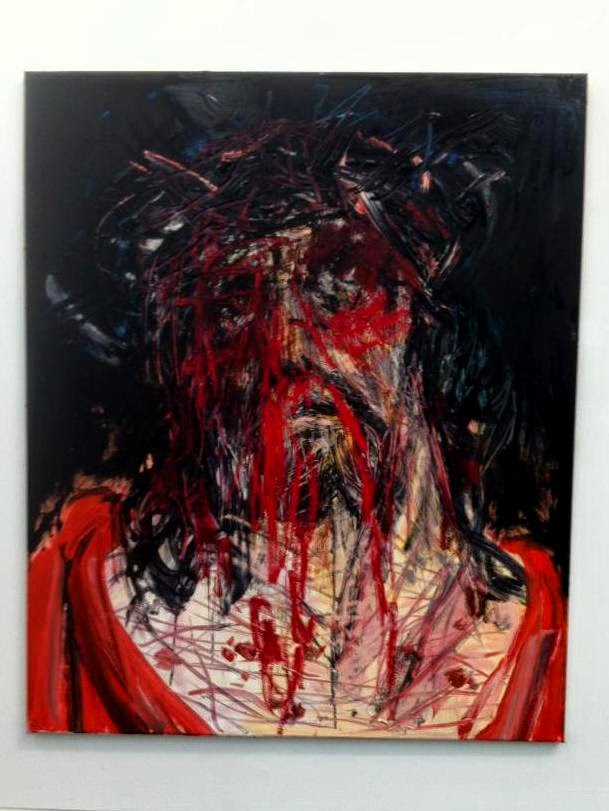
The measurements are 120cm x 100cm, the surface is rough, though not as scattered and scarred looking like on the flower paintings. The colors are strong and this painting is open to several interpretations. In the exhibition leaflet it was stressed that these paintings of Marila are ironic and the humor has a meaning.
I myself am not convinced that this would be the case with the paintings or even half of the paintings in the exhibition. If for example those "Flowers XIX" and "Flowers XXVII" are ironic, what is the target of irony? Is it the art history and still life paintings and if so, why? The same problem is with this "Christ I" the viewer has way too many options to interpret it "ironically" so basically the artwork itself does not necessarily have the quality of irony and satire. Is it ironic towards Christianity, or just the way Jesus Christ is depicted these days with lot less gore and suffering? Or is it like a caricature or smeared for fun saying all religions are stupid?
Visually I think this Christ is pleasant with it's oddities so the flower paintings but I don't think they have some huge social importance via irony. What do you think of all these paintings?
Thursday, 19 June 2014
Gothic Art in Spotlight: sculptor Heli Ryhänen
I know I said I'd present a gloomy artist next time and this might not be that gloomy but I wanted to show you a Finnish artist called Heli Ryhänen because I recently stumbled to a website of an art gallery and was disappointed to notice that her exhibition had ended only few weeks ago. I started to google Ryhänen and found out she has marvelous public works, which might not be that gothic but are a bit disturbing, really funny and witty. The links are to the artists homepage which is in English too.
Ryhänen uses many materials to make her sculptors, including light, which I think is often overlooked. I love it when the artist has completed the statue, installation etc. with light and at the same time with shadows, that make the atmosphere different and sometimes alienated of the rest of the exhibition room.
What I like about this installation is the atmosphere, which is instantly transformed with the name of the work; "Evil Shepherd". Something maleficent is lurking in the face of the big person on the camp fire. I love how the faces of these creatures are so detailed but the feet are turning into almost sketches. They are not as finished and I think that makes the installation even creepier, as if the Evil Shepherd is luring others to dissolve their humanity and their feet are already gone.
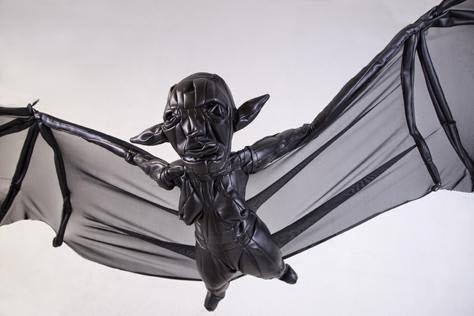
Ryhänen uses fabric as a material for the sculptures, which distinguishes her from many other artists. She was recently nominated as the Artist of the Year at the he exhibition I missed. That exhibition was called 'Species of People' and I sure would have loved to see this beauty in real life:
The name of this work is 'Reviiri' which means territory or personal space. In Finnish this word usually refers to animals and their territories and living areas but it is used of humans too. It highlights that delightful idea of a contrast between human and animal, since this flying creature is something between those two. I love how her legs are cute and puffy but her face is Yoda-like old and slightly mean-looking or just sour.
Thanks for reading and once again, back in two weeks with another Gothic Art in Spotlight!
Ryhänen uses many materials to make her sculptors, including light, which I think is often overlooked. I love it when the artist has completed the statue, installation etc. with light and at the same time with shadows, that make the atmosphere different and sometimes alienated of the rest of the exhibition room.
![]() |
| Source |
What I like about this installation is the atmosphere, which is instantly transformed with the name of the work; "Evil Shepherd". Something maleficent is lurking in the face of the big person on the camp fire. I love how the faces of these creatures are so detailed but the feet are turning into almost sketches. They are not as finished and I think that makes the installation even creepier, as if the Evil Shepherd is luring others to dissolve their humanity and their feet are already gone.
Ryhänen uses fabric as a material for the sculptures, which distinguishes her from many other artists. She was recently nominated as the Artist of the Year at the he exhibition I missed. That exhibition was called 'Species of People' and I sure would have loved to see this beauty in real life:
![]() |
| Source |
The name of this work is 'Reviiri' which means territory or personal space. In Finnish this word usually refers to animals and their territories and living areas but it is used of humans too. It highlights that delightful idea of a contrast between human and animal, since this flying creature is something between those two. I love how her legs are cute and puffy but her face is Yoda-like old and slightly mean-looking or just sour.
Thanks for reading and once again, back in two weeks with another Gothic Art in Spotlight!
Wednesday, 18 June 2014
CorpGoth's Mid-Month Status Report: Work space
It is the middle of the month so Trystan From This Is CorpGoth has asked people to show how they goth up their work place, cubicle or other. Unfortunately my 'work place' is in my home because I am studying and you can't really go and decorate a computer in the university's computer class or anything. So I do not have that need to decorate and make myself and my personality visible at some other place like in the office. My personal stuff is all around me every second. :)
![]() |
| This framed postcard used to be at the work table, now it's next to bed. |
![]() |
Le Fanu's famous horror stories. I have not yet started to read them but I am planning to start them today. Underneath are some dictionaries and other stuff.
Here you can see how after the 'work area' there is just bunch of stuff. The Asian ladies are my small travel make up bag I got from my mother. Behind them peeks a coffee cup from the morning.
Thanks for reading and do check Trystan's and other participants' posts too!
Thursday, 5 June 2014
Gothic Art in Spotlight: Jean-Michel Fauquet
Once again this post is about to begin with the words 'when I was in Paris', since it is vital for the post. I went there to Maison européenne de la photographie, where there were works of several artists on display. One of them almost took my breath away.
This exhibition has unfortunately ended, but in the bottom floor were the works of Jean-Michel Fauquet. I am not trying to undermine photography as art when I say that those works of art were not just photographs. It was clear the artist had used other things too, other techniques and other instruments to make those works of art. All information about the pieces were in French and unfortunately my vocabulary is not that grand when it comes to a specific field of methods of making art. Of coarse I could have googled all words but honestly, I was too busy just admiring those photos / paintings / installations.
Fauquet has used many different techniques to make his art works the way they are. Many of the works resemble more an oil painting than a photo. I fell in love with the eerie atmosphere of the exhibition and the paintings / photos. I think these works of art are gloomy, bleak, sad and extraordinarily beautiful. I especially adored this grand collage.
I found some information at the web page of Gallerie VU' about Fauquet and his works and photos of some photo-paintings I had not seen at the exhibition. Those were really interesting works and the analyze of Fauquet's works and their style is spot on why I consider them rather gothic.
Back in two weeks with another gloomy artist!
Monday, 26 May 2014
Almost Gothic Art in Spotlight: Deranged Horses
As I mentioned in a previous post, this time I shall write about grotesque horses in portraits. I was on a short holiday in Paris and I visited many art museums, including Louvre, and there were numerous paintings of presumably great men with their horses.
Now, I am not an expert on horses (I have never ridden a horse or at least I do not remember that traumatic episode) but I am pretty sure they are not deranged beasts whose mouth foams and the eyes are wild and maleficent. Unlike my thoughts, that is the general comprehension in most of the paintings starting from 17th century all the way to the time when horses no longer were used on battle field. I took some photos again with my phone's camera so I apologize the less than great quality of photos but here are some deranged horses!
This one above is a detail of a larger painting, it was about stealing some maiden but I can't remember who. As you can see the horse is either foaming like a lunatic or that is smoke coming from it's mouth.
This one with the dead tiger is my personal favorite, the sky is so shockingly blue and the tiger skin is almost vivid and the whole painting is at the same time cute as a candy with all that bright color and still the horse is angry with its 'foaming mouth' which looks to me like it is spitting milk. And there is some random army running towards this demonic horse!This painting is so tacky and slightly grotesque that I can not help but like it.
Unfortunately I did not remember to take pics of the little signs with the paintings' names and artists, so I have no idea who have painted these. But in this one the rider has clearly understood that his stallion ( I have no idea is this a male horse but I do believe people call them stallions) is possessed by a demon or something since he is attacking his companion with a sword.
Need I say anything about this painting? The man looks like a saint because the helmet is made much shinier than other parts of the painting and the feather of the helmet looks like a halo. The horse does not seem to like it at all. The back ground is pleasingly grim.
What do these horses have to do with gothic art? Not so much on the first look but when you think about the etymology of the word 'goth' which originates from those brutal tribes that molested the ancient Rome, I believe there is a resemblance with the words I used to describe these beastly horses. These horses hit my twisted sense of humor and I myself value that sense of humor a big part of my identity as a goth. Therefore I could very well integrate a painting of a demonic horse to otherwise gothic decor.
When I was visiting St. Petersburg there were some bizarre paintings of dogs attacking almost everything. I did a post about them and this strange fascination to beastly horses comes from the same part of my personality as the infatuation of those ghastly hounds.
Next week I shall return to the 21st century and to the art of photography. Thanks for reading!
Oh, and a day or two after I visited Louvre and the horses I saw some live ones too! It was a parade to celebrate the end of the World War Two.
Wednesday, 21 May 2014
Greetings from Paris, Catacombs and a Greek tragedy
It has been disgustingly long time since I have posted. The fault is that I have had the last exams and essays to return (well, who hasn't in the spring?) I have also been on a holiday in Paris and I have moved to a different city, at least for the summer! So you can imagine that it has been a very busy month!
Here are some photos (taken with a phone so I apologize the poor quality!) from the Catacombs of Paris and a few pics of the National Opera of Paris, where I went to see a ballet Orphée et Eurydice at the Palais Garnier. I went there an hour before the start of the ballet because then the tickets are cheap. Of coarse the tickets that are available at that hour are the crappiest places, where you can see only 50% of the stage IF you are LUCKY. It was still worth the 10 euro fee, the music and the singers were awesome, the whole set design and costumes were simple and modern and the dance was amazing (at least the parts that I saw ;) ).
If you can't remember at the moment, the story of Orpheus and Eurydice is a tragedy in which the two main characters fall in love but the lady dies. Orpheus travels to hell to retrieve his love. He has the ability to play music so beautifully that the ruler of Hell promises that Orpheus may take his love but Eurydice must walk behind him and Orpheus is not allowed to look back to make sure she really is following. Otherwise she will be damned to hell for eternity. Well, Orpheus is unable to resist the need of a little peek and loses Eurydice for all eternity. He wonders the land in grief and in the end a gang of Maenads (female followers of Dionysus, basically ravers of the Antiquity) bump into Orpheus and the ladies tear him into pieces.
When I visited all those art museums in Paris, I got this feeling that the legend of Orpheus and Eurydice is or was really important to the French because there were about hundred paintings of this legend in the Louvre alone. Mostly from the 18th and 19th centuries but I am not sure if I remember correctly.
The catacombs were worth the waiting. You have to wait in line at least one hour to get there but the catacombs are extremely fascinating!
I did not take selfies during my holiday except this one because two American tourists provoked me too to take 'a selfie with a dead person!' :D What a lovely macabre sense of humor they had!
Next time something about art: Grotesque paintings of horses!
Here are some photos (taken with a phone so I apologize the poor quality!) from the Catacombs of Paris and a few pics of the National Opera of Paris, where I went to see a ballet Orphée et Eurydice at the Palais Garnier. I went there an hour before the start of the ballet because then the tickets are cheap. Of coarse the tickets that are available at that hour are the crappiest places, where you can see only 50% of the stage IF you are LUCKY. It was still worth the 10 euro fee, the music and the singers were awesome, the whole set design and costumes were simple and modern and the dance was amazing (at least the parts that I saw ;) ).
If you can't remember at the moment, the story of Orpheus and Eurydice is a tragedy in which the two main characters fall in love but the lady dies. Orpheus travels to hell to retrieve his love. He has the ability to play music so beautifully that the ruler of Hell promises that Orpheus may take his love but Eurydice must walk behind him and Orpheus is not allowed to look back to make sure she really is following. Otherwise she will be damned to hell for eternity. Well, Orpheus is unable to resist the need of a little peek and loses Eurydice for all eternity. He wonders the land in grief and in the end a gang of Maenads (female followers of Dionysus, basically ravers of the Antiquity) bump into Orpheus and the ladies tear him into pieces.
When I visited all those art museums in Paris, I got this feeling that the legend of Orpheus and Eurydice is or was really important to the French because there were about hundred paintings of this legend in the Louvre alone. Mostly from the 18th and 19th centuries but I am not sure if I remember correctly.
The catacombs were worth the waiting. You have to wait in line at least one hour to get there but the catacombs are extremely fascinating!
![]() |
| 'Stop! Here lies the empire of death' |
I did not take selfies during my holiday except this one because two American tourists provoked me too to take 'a selfie with a dead person!' :D What a lovely macabre sense of humor they had!
Next time something about art: Grotesque paintings of horses!
Tuesday, 25 March 2014
Gothic Art in Spotlight: a book about HR Giger's art
It has been an annoyingly long time since I have posted in this blog. It is a shame but the main reason is that I haven't had time to read gothy art books nor there have been any great exhibitions I'd consider suitable as a topic in this blog. But now I have something!
This art book titled HR GIGER is of coarse about HR Giger's art works, from movie props (Alien films) to drawings and statues. It was published in the beginning of 21st century though oddly enough I did not find my copy on the webpage of the publisher. There was some other art book about Giger but not the one I have in my shelf. The one I have can be found in Amazon, new ones are about 10 dollars and used ones cost almost nothing! If you have some petty cash, I strongly recommend to get this book since the pictures are amazing and it gives the reader a peek into such a wide range of Giger's work. :)
In this book there is no one author. The whole concept of this art book is HR Giger's, but there are texts made by several other people. For example the preface of the book is by Leslie Barany, a personal friend and agent of Giger.
What I really like about this HR GIGER is that the content is compartmentalized in logical sections. After the preface the next part is titled "HR Giger and the Soul of the Twentieth Century". The text is written by Stanislav Grof who to my taste makes a really good presentation of Giger's art and why Grof considers Giger a visionary. Grof places Giger and his work into several contexts, he refers to the psychological aspects of Giger's work and also how they reflect the 20th century, the rapid technological development and cultural change.
All texts are in English, French and Germany. It also gives some inside information about how the Giger Museum was established and what kind of misfortunes happened but what is really nice is that the book does not dwell on those mishaps, all texts are compact and therefore give room for the most important thing; the photos of artwork by Giger.
Thanks to this book, I really want to visit the Giger Museum! :) Yesterday I actually checked what would it cost to fly to Gruyères, Switzerland (where the museum is) but alas, there were no flight routes from Finland!
Thanks for reading!
Subscribe to:
Posts (Atom)