Monday, 29 August 2016

Creepy Reads Review: Cruel Beauty by Rosamund Hodge

This months Creepy Reads Review is of a novel a friend gave to me. I had visited her at Tampere and on my way back home I needed something new to read on the train. My friend had a pile of books she wanted to give away. So, these book were not her favourites but I still decided to read one of them. I admit it was because of the pretty cover and the promise that it has intertextual references to may fairy tales. The novel I chose was Rosamund Hodge's Cruel Beauty.
My copy's cover is already a bit worn.

A mash-up of genres


As promised, the novel draws inspiration from several myths and fairy tales, the most obvious ones are the Blue Beard and the Beauty & the Beast. These two have a straight impact on the plot. On the thematic level the novel is more close to the ancient Greek myths (mostly tragedies) which clash amusingly with the 'happily ever after' mentality of the Beauty and the Beast fairy tale. There are also strong references to the story of Rumplestiltskin and a more recent fantasy story the Labyrinth, a film starring David Bowie.

Greek tragedies and fairy tales not being enough, Cruel Beauty is also a chic-lit romance story and at some points it almost seems like one of the Harlequin novels. I do not often read romance stories but Cruel Beauty combines successfully some sense of humor and wicked dialogues to the romance, so I found it mostly entertaining.

However, there was a bit too much repetition with these romantic scenes. Some times there seemed to be no point, why some elements and lines and deeds were repeated in several scenes. One could always argue that repetition is an important motif from the fairy tales. I thought that sometimes the repetition stated to resemble the way a soap opera has constantly repeating romantic situations and how the soap opera characters dwell in their feelings.

A tiny bit about the story


Since I do try to avoid spoiling the possible future reading experience of  the books I introduce in the Creepy Reads Reviews, I am not going to speak about the plot twists of Cruel Beauty. But I do wish to present some of my impressions and thoughts about the story.

The starting situation of the novel is the following: The narrator and the main character is a 17-year-old girl named Nyx. She lives in a world ruled by a demon lord. Nyx is to be marry that demon because of a plot made by her father. Nyx is trained to be an assassin and her destiny is to free the world of its evil demon ruler. Of course, not everything goes according to Nyx's father's plan nor are all characters what they first seem.

I very much enjoyed that the narrating main character Nyx is not a nice person. She is not the usual pure hearted heroine. Instead her childhood has molded her into a vengeful and disappointed creature with a heart filled with grudge towards her own family ('the good ones') and a sharp tongue. And who can blame her? She is treated coldly by her father and trained to be a vessel of revenge, a knife others want to use. The hidden anger inside Nyx makes her a much more interesting character than what teenage heroes or heroines usually are.

Conclusion 


All in all, I thought this was a nice reading experience and I especially liked the way the world of this fantasy novel was constructed. The characters had a religion mostly inspired by the Ancient Greek and Roman traditions and it is evident Hodge knows a lot about ancient Greece and its myths. The story-world of Cruel Beauty was estranged but welcoming for the reader, and I probably will read more Hodge's novels in the future.

I can recommend this novel, if you occasionally enjoy a good chic-lit, like to read fantasy and like to read descriptions of magical castles and their beautiful rooms.

Saturday, 13 August 2016

Gothic Art in Spotlight: Ghosts and creepy sculptures

The road trip in July took me to the city of Joutsa in Central Finland. There resides the Art Center Haihatus (could be translated as a daydream or a fanciful idea). It is an artist run art center and they hold every summer a grand exhibition. Artists can also apply for residency in Haihatus.

The exhibition area consists of three buildings and their garden, and a field area next to them. The place was filled with all kinds of works but mostly installations or statues, like this dragon like creature:
The three buildings have names, Haihatus, Utopia, and Fantasia. In Utopia was the main exhibition, or at least I felt like it. This skeleton is a small detail (it is the size of a two-year-old) of an installation that filled one room. I'm not sure if it is done with papier-mâché or is it some sort of clay.
In the attic was a grand installation by Jouko Korkeasaari. The name of the work is "Ett spök, spöket, spök" which is oddly almost Swedish. It almost says "A ghost, the ghost, ghosts", like in a dictionary but it is spelled wrong. I am pretty sure that is the point, because these creatures looming between hanging sheets are almost like ghosts, but there is something wrong in them.
I think the one above seems to be afraid of the viewer. Usually ghosts are supposed to be the scary ones.
This too seems like it is reserved. In the back of the room was a window open, so the sheets moved a bit in the breeze. Very spooky!

In the building called Fantasia we found the most bleak or grim works. The rooms were very dark, there were practically no lights and I guess I missed some information board or something because I could not find information about who made these works. Nor have I any idea what the titles of the artworks are.
This here is some sort of a mummified troll. Not real, of course. The text says "Please do not feed the trolls". Underneath was placed a typewriter, perhaps as a symbol for making up stories and fairy tales.
This here is a very old basin for bathing little children. The legs are from an old table and the basin is filled with bones. Clearly bones of a quite large creature.
No idea what is the point of this but it is cute in some very odd way. The feet have little paws so it sort of looks like a very abstract version of a pet.

I hope you found these works interesting! Next time I'll be back with another Creepy Reads Review.

Tuesday, 2 August 2016

Creepy and geeky art treasures at the Serlachius museums

As I promised in my previous post, I am going to continue writing about my art road trip. After the city of Tampere and Ron Mueck's installations our next stop was at Mänttä-Vilppula, the city of art as they are called. This nickname came because a very influential family Serlachius lived in Mänttä-Vilppula and the members of this family loved art, especially a man called Gösta. The Gösta Serlachius Fine Arts Foundation was created and the artworks they've acquired are displayed in Serlachius museums at the city of Mänttä-Vilppula.

Art Museum Gösta


The art museum is named after Gösta. They have a new extension to it, Gösta's Pavilion and in there they feature contemporary art. This summer they have a big exhibition of Mark Wallinger's works, open until 9th of October 2016. Wallinger is a painter, sculptor and a video artist. His works, materials and style varies a lot.

This are from the series of id Paintings. The inspiration came from Sigmund Freud's theories and the concept of id and I presume also from the idea of subconscious. They look like huge versions of the Rorschach test. They are taller than an average human, and in the exhibition room there were about 20 of those paintings. It made a person feel really small.

The Rorschach test is a test based on association and interpretation. The patient (or a person examined) looks at cards with ink spots and tells what she/he thinks they look like or symbolize. These interpretations are then seen as sort of messages from the persons subconscious and from them others can try to judge if this person is having stress or for example mental problems.

I would like to note that I have not studied psychology and that short explanation is a simplified and possibly quite crude way to describe the Rorschach test. I personally think that doing/playing this sort of an association game can be fruitful but people really should pay attention to the fact that humans do not share all symbols: for someone a butterfly is a joyful thing, for another one it symbolizes fragility.

It was actually quite fun to start to really look at these paintings and try to analyze and imagine what all those shapes formed. In this painting I saw two mountain hares hanging from something. Possibly they are today's catch and someone is about to make dinner of them. What do you see in this painting?

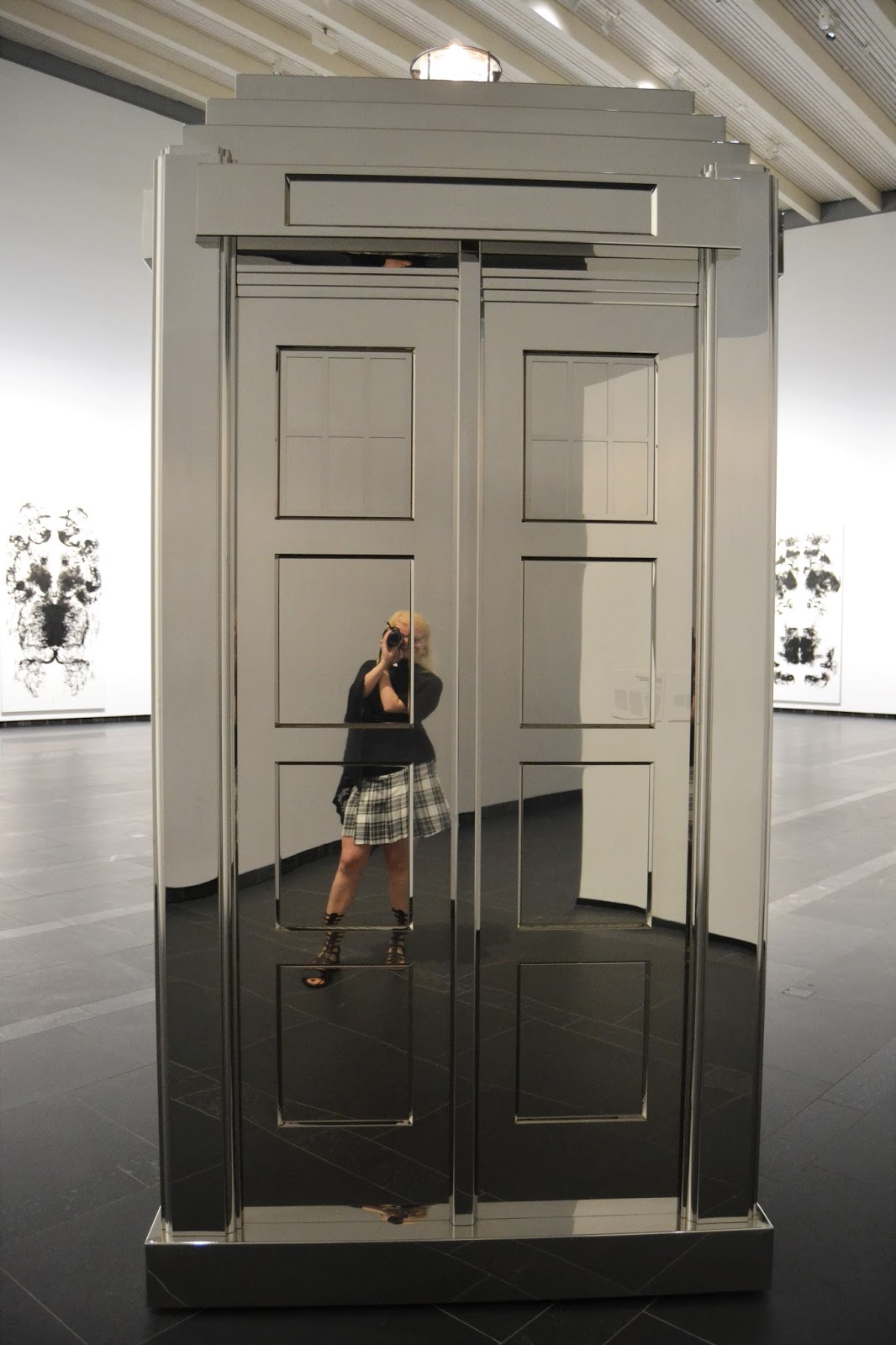
The id Paintings were made 2015. This sculpture named Time And Relative Dimensions In Space is from year 2001.
As I mentioned in the previous post, there was something that reminded me of Doctor Who. If you picture this shiny box to be blue and have the words Police Public Call Box on it, you'll understand.

Here is me next to it for measurement. Its outer dimensions (aka size) are almost exactly the same as Tardis has. They might even be the same, alas I have never seen Tardis or the props they have for the TV show.
I did not touch it because I am a law abiding art museum visitor and it was highly prohibited. Wanted to, though.

Museum Gustaf


Those were some works at the Gösta Art Museum. In Mänttä-Vilppula there is another Serlachius Museum named Gustaf. They usually have exhibitions about history and technology but this summer they also had an exhibition called Landscape. It was an interactive exhibition in which people could learn about the history of landscape art, and create their own landscapes of the pieces of famous landscape paintings.
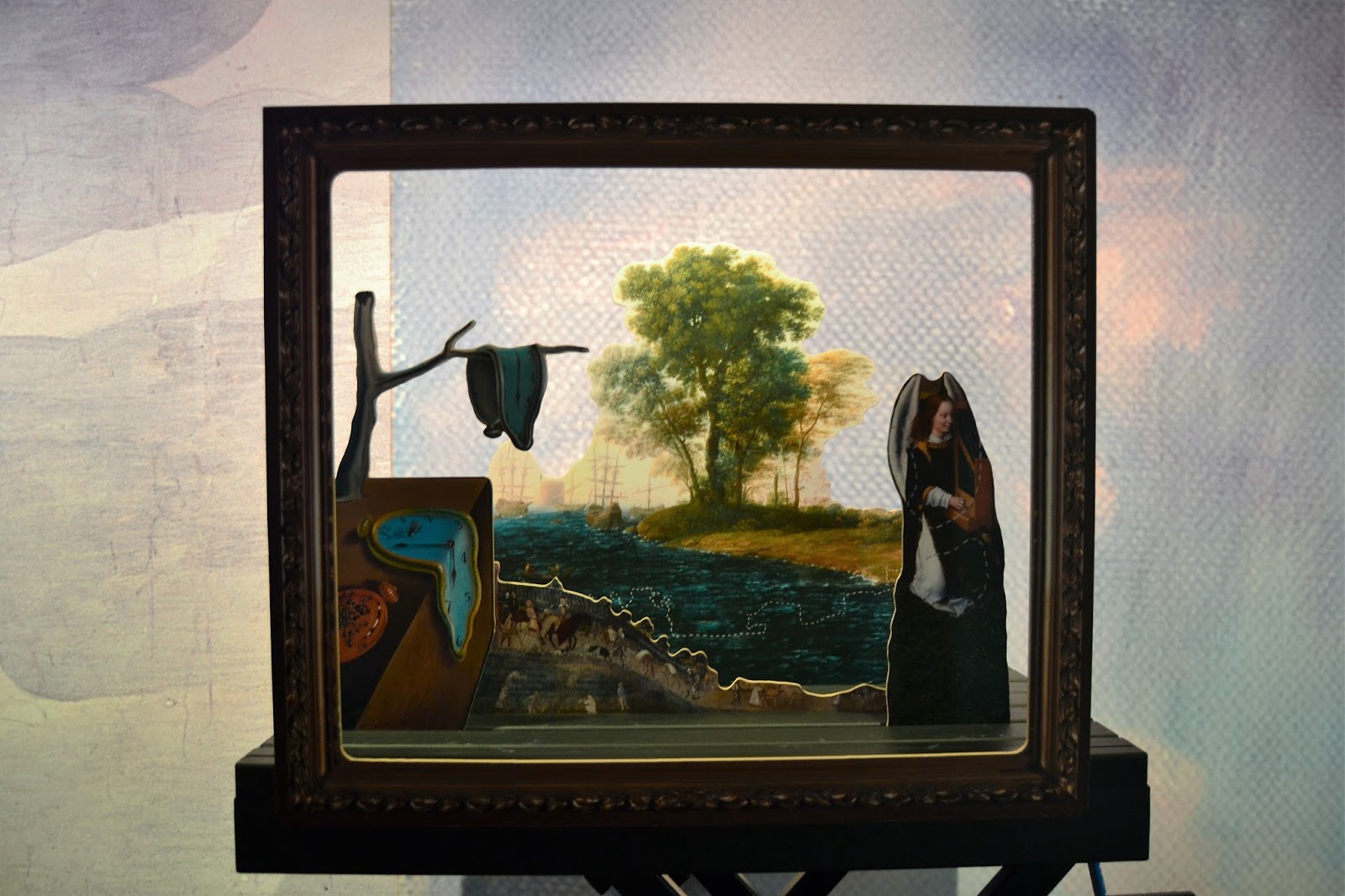
From the photo above you can see the entrance. Maisema means landscape and on the right there are pieces of famous paintings. Inside the room there were sort of tables with frames. On the other wall there were replicas of famous paintings, the pieces of paintings for constructing one's own landscape (in the shelves), and video screens. The videos were about landscape paintings and their history.
Here are two installations I made. The other one is with Dalí's watches and a random angel.
And the other one is a mix of some winter paintings. A more classy combination, I'd say. Do click the images for a larger view and better details. I took these photos with a real camera, not my phone, so the quality is not that devastatingly bad.
I hope you enjoyed this post. I had fun at the museums and fun writing about them, and I do hope some of that happiness and enjoyment shines through this post.

Next time: cute and macabre art from the next destination on my road trip!

Tuesday, 26 July 2016

Gothic Art in Spotlight: Uncanny Giants of Ron Mueck

Last weekend I went for an art road trip in a small but selected company. This means that we left the capital of Finland and traveled through ten art museums and other summer exhibitions during three days.

The route took us from Southern Finland to West, the city of Tampere, and then to Eastern Finland. You can roughly see the route here in this map in purple, it's unimaginatively named as 'Art Road Trip'. The distance me and my entourage traveled was about 600 km (370 miles).
Map made with karttaikkuna.fi
The places we visited on Friday were:

Riihimäki art museum
Hämeenlinna art museum (Riihimäki and Hämeenlinna are the names of different cities)
Sara Hildén Art Museum

Sara Hildén (1905–1993) was a Finnish businesswoman and a patron of arts. She started an art foundation (named after her) in 1962. The foundation concentrated on modern art but they do hold exhibitions of contemporary art these days. This summer they are hosting a solo exhibition of Ron Mueck. Previously they've had solo exhibitions of many famous artists, among them Andy Warhol.
Mueck is an Australian artist, and has made only 40 works. 10 of them are displayed this summer at Sara Hildén Art Museum in the city of Tampere. The works are extremely life-like sculptures that are in some way out of proportion. They are either outrageously large and hence uncanny or very small. 

I found the exceptionally large works delightfully disturbing. among them were a giant couple under a parasol, a human-sized dead chicken and a baby the size of a whale. 
The sculptures are detailed, they have individual hairs and pores and everything. This might be a weird thing to say, but the sense of 'flesh' was very strong in the exhibition. 
Unashamed I used random people as measuring sticks for these art works. The sculptures would not look so exceptional, if you could not understand the size of them. I think this gigantic baby is fascinating and at the same time repelling. 

What do you think of Ron Mueck's art?

Next week: the treasures of Serlachius Museums, among them something that will probably remind you of Doctor Who!

Tuesday, 12 July 2016

Gothic Art in Spotlight: The everyday cruelty in Jarmo Mäkilä's art

Some time ago I went to see the art exhibitions at HAM, Helsinki Art Museum. There were a couple of big exhibitions and a couple of small exhibitions in their facilities. The exhibition that made my little goth heart shiver the most was the exhibition From Heino With Love. Heino is the surname of a family that began to collect contemporary art. Their love for art gave birth to the Heino Art Foundation. This exhibition in HAM is the first time the public can see a glimpse of their extensive collection. The exhibition is on until 28th of August 2016.

Bleak and cruel childhood


The exhibition From Heino With Love featured many interesting contemporary artists but what really caught my eye on my visit to the museum were the works of Jarmo Mäkilä. His works often show the mundane cruelty of our everyday life. Mäkilä has made sculptures, paintings and installations. Many of his work have a sort of a horror film atmosphere, but some are terrible in a more documentary sort of way.

The piece I want to show you is named First Day at School (2007–2008). It is an installation of a miniature model of a school building. On the other side there is either a trail of toys leading to the school, or quite possibly escaping from there.
On the other side the building there are visible marks of violence. The windows are smashed and there are signs of a fire or an explosion.
For me this is a bleak description of a child's feelings when he/she is forced to go to a scary new facility for the very first time. Very big schools with not enough staff and too many bullies can seem like a hostile place to be.

What thoughts spring into your minds?

Art around the city


What I really like about HAM is that they also organize exhibitions outside the museum. At the moment one of the old boulevards for pedestrians in the center of Helsinki is the showplace for an installation by one of the best known contemporary artists: Japanese Yayoi Kusama.
Kusama has wrapped the trees into polka dots. The whole street looks like this. A bit like Wonderland, isn't it?

HAM also has an exhibition room or a window in the nearest metro station (simply named as HAM metro). It is a sort of a glass cage for the art on the platform so people waiting for the next metro can look at some art while they are on the platform.
At the moment HAM features large paintings by a Swedish graffiti artist Kaos.

I hope you enjoyed this post!

Tuesday, 28 June 2016

Creepy Reads Review: The Graveyard Book by Neil Gaiman

I recently read a novel by Neil Gaiman and wanted to feature it here in the blog. The name of that novel is The Graveyard Book. It tells the story of a little orphan boy who ends up in the graveyard and the ghosts raise him up, with some help from another person or creature living in the graveyard. I really liked that the narrator never actually says what this guardian type of character is. It is implied that he has many traits of a vampire, though.
The Finnish translation's cover
The world of this novel has supernatural and fantasy elements straight in the beginning. As is typical for the novels and graphic novels of Gaiman, around the fantasy elements there looms the normal magic free reality, but none of the main characters belong strictly to the normal world. I liked this book and want to encourage others to read it too, so I try my best to avoid spoilers.

The story begins with a scene in which a man named "Jack" kills a family, but their toddler manages to escape to the graveyard close by. The toddler is found and rescued by ghosts. He does not speak yet and hence has no name. The ghosts decide to call him Nobody. It is clear that the toddler is very important for some reason. The story of the boy Nobody and his family opens up slowly during the novel. Strong themes in this novel are loneliness and personal growth.

The Graveyard Book is categorized as a fantasy novel for children. I agree that children and teenagers are clearly the target audience, which is a slightly younger audience than what many other novels by Gaiman have. As an example I could mention Neil Gaiman's graphic novel series The Sandman and the novel Anansi Boys. It's been years since I read that one, but I have this faint memory that if considering ethics and who is evil and who is not, Anansi Boys was a lot more 'gray area' than The Graveyard Book. Which is great like that, since in Anansi Boys the characters are adults but in The Graveyard Book the main character is a boy growing up from being a helpless toddler to a youngster. The narration kind of leans towards the cognitive skills of a young boy, without being infantile.

The illustrations in this Gaiman's novel are made my Dave McKean, who has illustrated many other goth-y stories and books too. One featured before in this blog is The homecoming by Ray Bradbury. If you check that post out, you'll notice that in The homecoming the illustrations are more tightly knitted to the text than in The Graveyard Book.

I really liked The Graveyard Book. The plot structure was a mix of a growth story and a swashbuckler or an adventure story. They are both rather predictable plot structures but the novel was still very enjoyable and did not use any really stereotypical cliches. Strongly recommend!

Thursday, 9 June 2016

Gothic Art in Spotlight: The Black Paintings of Goya and a trip to Madrid

I spent the last full week of May in Madrid, as a sort of a summer holiday because I am going to be working the whole summer (of which I am glad!). In my previous blog post I already mentioned that this spring would be very busy for me and I was not wrong. I have finished my studies and before I traveled to Madrid, the capital of Spain, I had emptied and cleaned my apartment in Tampere, the city where my (soon to be ex-)University is. I returned from Madrid  two days before my new work began and for the past week I've been still very busy, learning the new job.
The view from the hotel room in Madrid
In Madrid I visited many amazing art museums and saw many great paintings and statues by famous and not so famous artists. The works were beautiful or thought-provoking but not something that was hitting that "goth spot", if you know what I mean. :) The most goth paintings I saw on my trip would be Francisco de Goya's "Black Paintings". I saw most of them at the Museo del Prado, the distinguished art museum with the largest collections in Madrid. They had a whole room full of Goya's grim and ominous paintings.

The Black Paintings are paintings Goya (1746–1828) made between 1819 and 1823. He used much darker colors and shades compared to his earlier works and most importantly, the paintings depicted sinister and horrifying things. This is a painting called "Saturn eating his son" and the name is quite explicit. Saturn, the father of Zeus and other gods of Ancient Greece, is devouring his own son because there was a prophecy that one of Saturn's own children would kill him. So he would eat them all. This is a striking and obscene painting.
Source
I must admit that I've never been a fan of Goya and the Black Paintings do not make my heart shiver nor do they put me into awe. The subjects of the Black Paintings are interesting but something in Goya's style just isn't suitable for me. Goya also made some paintings of witches and their grim rites in the end of the 18th century. Their colors are lighter but subjects are not. In this painting a group of witches are having a feast with the incarnation of the devil or another demon and they are offering dead or ghoulish children to him. Or at least that is how I interpret this scene.
Source
These paintings could easily delight and interest goths. The macabre and twisted elements are fairly visible and they have a sort of a timeless vibe in them, with the mythical themes and folklore-ish subjects.

As a side note: Museo del Prado is now having an exhibition of Hieronymous Bosch and his works and it looks like it is amazing. Alas, I could not see it because I had to return to Finland before the exhibition opened. The exhibition is the biggest exhibition of Bosch this year. If you happen to be in Madrid in near future, that Bosch exhibition is definitely worth checking out!