Thursday, 9 June 2016

Gothic Art in Spotlight: The Black Paintings of Goya and a trip to Madrid

I spent the last full week of May in Madrid, as a sort of a summer holiday because I am going to be working the whole summer (of which I am glad!). In my previous blog post I already mentioned that this spring would be very busy for me and I was not wrong. I have finished my studies and before I traveled to Madrid, the capital of Spain, I had emptied and cleaned my apartment in Tampere, the city where my (soon to be ex-)University is. I returned from Madrid  two days before my new work began and for the past week I've been still very busy, learning the new job.
The view from the hotel room in Madrid
In Madrid I visited many amazing art museums and saw many great paintings and statues by famous and not so famous artists. The works were beautiful or thought-provoking but not something that was hitting that "goth spot", if you know what I mean. :) The most goth paintings I saw on my trip would be Francisco de Goya's "Black Paintings". I saw most of them at the Museo del Prado, the distinguished art museum with the largest collections in Madrid. They had a whole room full of Goya's grim and ominous paintings.

The Black Paintings are paintings Goya (1746–1828) made between 1819 and 1823. He used much darker colors and shades compared to his earlier works and most importantly, the paintings depicted sinister and horrifying things. This is a painting called "Saturn eating his son" and the name is quite explicit. Saturn, the father of Zeus and other gods of Ancient Greece, is devouring his own son because there was a prophecy that one of Saturn's own children would kill him. So he would eat them all. This is a striking and obscene painting.
Source
I must admit that I've never been a fan of Goya and the Black Paintings do not make my heart shiver nor do they put me into awe. The subjects of the Black Paintings are interesting but something in Goya's style just isn't suitable for me. Goya also made some paintings of witches and their grim rites in the end of the 18th century. Their colors are lighter but subjects are not. In this painting a group of witches are having a feast with the incarnation of the devil or another demon and they are offering dead or ghoulish children to him. Or at least that is how I interpret this scene.
Source
These paintings could easily delight and interest goths. The macabre and twisted elements are fairly visible and they have a sort of a timeless vibe in them, with the mythical themes and folklore-ish subjects.

As a side note: Museo del Prado is now having an exhibition of Hieronymous Bosch and his works and it looks like it is amazing. Alas, I could not see it because I had to return to Finland before the exhibition opened. The exhibition is the biggest exhibition of Bosch this year. If you happen to be in Madrid in near future, that Bosch exhibition is definitely worth checking out!

Saturday, 30 April 2016

Personal update and some uncanny art

Once again a month has passed by. I have been working on my thesis relentlessly and I am happy to say that in two weeks it shall be finished and I will graduate this semester! That will mean that I have more time to write this blog. ^__^ Another thing that has been preoccupying my free time for the past couple of months is the search for an apartment. In the beginning of June I start working in a different city and need to find a place to live. I am really excited because a new chapter is beginning in my life.

For the past couple of months I have visited several art exhibitions but they have not often suited the themes of this blog a.k.a. the artworks I've seen have not been extremely "goth" nor have they represented darker aesthetics. This installation is something I would like to feature. I think it is rather uncanny.

This installation was made by Finnish artist Mia Hamari. Another work of hers was featured in this post in January. The name of this work is "Manual, Siberia, Jester, Party". It is made of two figures. A more human-like creature and an animal with a human face. Hamari draws inspiration from dreams and the subconscious. Her works often feature a human-animal metamorphosis. In this work there are also mechanical/clockwork aspects to them, since the other one has wheels instead of back limbs.
This work was exhibited at the Gallen-Kallela Museum. Gallen-Kallela is one of our national artists and the museum is his old home turned into an exhibition place. There are changing exhibitions and this work of Mia Hamari can be seen till the end of May 2016.
As you can see, this artwork is made of mixed materials, among them bronze, wood and parts of animals. The animals Hamari uses in her art have died in accidents. She has also used human parts like hair and eyelashes. Presumably they are of her own or donated to her.
This smaller statue is the size of a small terrier or another dog. What I really like about this installation is that the expressions on both the creatures' faces are a bit ambiguous, one can easily interpret several different feelings. This way the work can express different feelings and atmospheres, depending of the viewer. The small one is looking up and the taller one has closed its eyes. Though the small one has no pupils in its eyes so nobody knows if it can even see. Very uncanny.

I hope you liked this installation of Mia Hamari!

Sunday, 27 March 2016

Review: Macabre card game Gloom

Today I would like to feature a card game suitable for goths and other darkly inclined. The game is called Gloom and it is designed by Keith Baker.
This game of "inauspicious incidents and grave consequences" is hilarious and twisted. Each player has a family they play as and the goal is to make one's own family members as miserable as possible and eventually cause their untimely deaths.

Here are my three favorite characters from two different families The murderous matriarch Old Dam, Cousin Mordecai ("Inbreeding is the least of his problems"), and Professor Helena Slogar, who "enjoys gardening, long walks in the moonlight, and reanimating the dead". I love the sinister humor of this game! As you can observe, the cards are transparent plastic. The family is placed in front of the player and cards are played on them.
During the game players can play life events (called Modifier cards), which can be either good or bad, on the characters. Then there are of course the "Untimely Death" cards which are played on characters too. The third playable card is called "Event" which is a card that is happening on the meta level of the game: it is not played on a character but for example with it the player can remove all Modifier cards from a chosen character or to stop another player from playing an Untimely Death.

The game ends when somebody's family is completely wiped out. Then the "Self-Worth Points" of all dead characters are counted and who ever has the most points wins. Here are some Modifiers with various Self-Worth points:
Half the fun is to tell a story as one plays the Modifiers on characters. In this following scenario on the character of Professor Helena Slogar is played a Modifier "Was mauled by a manatee" and then "Was swindled by salesmen". It will be much more fun if one tells these misfortunes in a form of a short story:
"Professor Helena Slogar was starting a new research project with aquatic mammals. She had started to test if she could infect a manatee with rabies. The tests showed positive outcomes and Professor Helena was very excited. So excited, that she became careless and while feeding the rabies ridden manatee she fell into its tank! Alas, she was mauled by the manatee."
"Bloody and torn she finally managed to climb out of the water tank and away from the raging manatee. She heard the doorbell ring and since the servant had a day off, Professor was forced to answer the door herself. On the doorsteps were two smirking salesmen, who were selling dictionaries with ridiculous prices. Suffering from severe loss of blood poor Professor ended up buying useless and old dictionaries, and was thus swindled by salesmen!"
In the end of this little story Professor Helena Slogar's Self-Worth Score is now -30. On the bottom there are instructions that effect the player whose character the modifier is played on. One can play Modifiers and Untimely Deaths to any character, whether they are her own or somebody else's.

I have the second edition of this game. In the original game all playable cards (Modifiers, Untimely Deaths and Events) looked like the Modifiers, meaning they did not have those symbols in the middle. But in my cards you can see that the Modifiers can be distinguished from the other cards easily:
The pictures in the middle were added to Events and Untimely Deaths because there are expansion packs (like Chtulhu version) in which the design changed and in Untimely Deaths there started to be pictures in the center. They are there in order to make it easier to spot which characters are dead of course. In the original, one had to take the character card and flip it when it died. These center pictures are suppose to make the game easier but I do not like this new design for one reason:

If the lights are correct (and they often are) one can spot what cards other players are holding. Since the cards are translucent one can easily see if the picture on the other side is of an Untimely Death or an Event.
On left is an Event and on the far right is an Untimely Death. You can see the "ghost of a crow" on the other side of the card. In the middle is a Modifier backwards, you should not be seeing that -20 points. :D Otherwise this would not matter but there are Event cards that allow one to take a card from an opponents hand and in that situation it is significant if one can spot which card is an Untimely Death.

Otherwise this is a fabulous game and I warmly recommend it! The idea of the game is funny, the characters and awful misfortunes they can encounter are imaginative, and there is also a tactical side to this game.

Monday, 29 February 2016

Creepy Reads Review: Textual demons and unnatural grotesqueness

Hello there!

I was not suppose to go a whole month without writing anything but unfortunately for the last month I've been extremely busy with my studies. So, I decided to feature two books I've been reading lately, that are related to my Master's Thesis. It's not as if I have any other life these days.

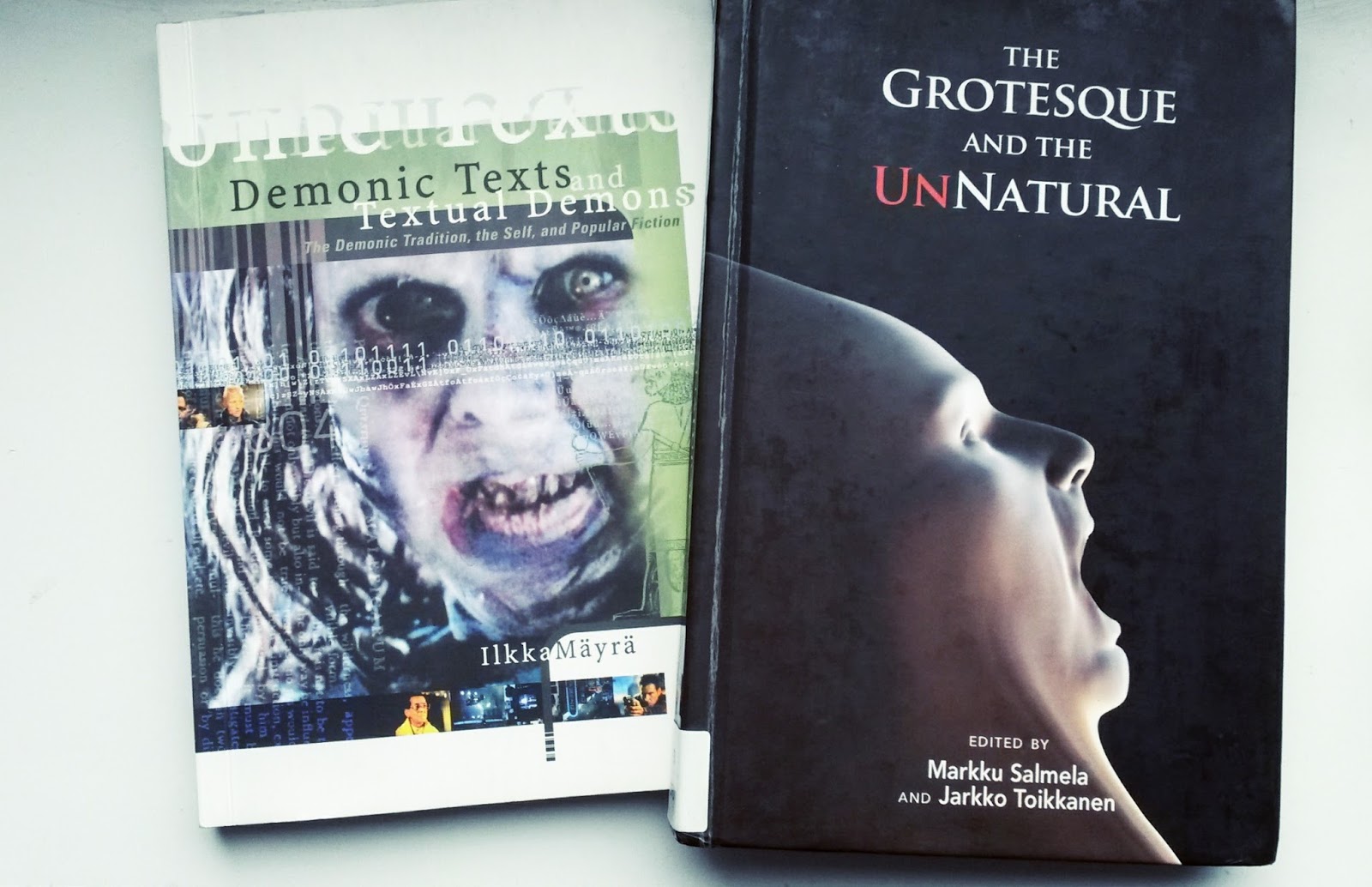
The other one of the books is the doctoral thesis of Ilkka Mäyrä named Demonic texts and textual demons: the demonic tradition, the self, and popular fiction (1999), and the other one is a collection of scientific papers, The grotesque and the unnatural (2011), edited by Markku Salmela and Jarkko Toikkanen.

As I've mentioned before, I am writing my thesis about grotesque in 21st century, in a French collection of short stories. In my thesis I construct a theory about what grotesque is nowadays and apply my hypothesis on the mentioned collection of short stories. Demonic texts and textual demons and The grotesque and the unnatural have been useful building blocks for me while I've pondered about the essence of contemporary grotesque.

The contributors of the collection of papers are researchers of literature and cultural studies who all find grotesque intriguing. Many of them emphasize how the way something is narrated or viewed creates the grotesque effect. This means that a human presence and participation is vital for something to be grotesque.

The papers of The grotesque and the unnatural are not purely about theory but instead many of them combine theories with analyses on novels or other products of culture and civilization. For instance, Mathilde Régent, who studied at Université Paris Diderot, contributed a paper about the grotesque in French medical discourse in the 16th century.

I of course have read this collection from the viewpoint of my own thesis but I believe for others too this could be an interesting read.

Ilkka Mäyrä's doctoral thesis is about demons in Western culture. It can be read online here, if my short introduction of it gets you interested.

In his thesis Mäyrä investigates what different roles demons have had and what things we consider demonic. He constructs theories and then applies them in case studies: among them The Exorcist and Ira Levin's novel Rosemary's baby. Mäyrä's work is both informative and entertaining. His writing flows easily and you do not have to be a literature student to understand it.

A great portion of Mäyrä's thesis is about how demonic features are linked to the self. He points out how in Ancient Greece people would explain the odd behavior of a human with daemons possessing him/her, and how in Freud's psychoanalysis the id (the unconscious part of the individual) has many demonic qualities. Needless to say that the way Mäyrä contemplates on the whole relation between "demon" and "human" has an essential role in my own thesis.

I can sincerely recommend both these books. I hope you too found this post of mine entertaining / interesting! :)

Short announcement: This spring will be very busy for me, I plan to finish my master's thesis in the beginning of May, so I shall be writing it 24/7 for the next two months. I do try to update my blog and read other people's blogs but I am not going to take any stress about it. Have a lovely March, and thank you for reading!

Sunday, 31 January 2016

Indigo: dystopic opera with a touch of metal music

Source
Yesterday I went to see an opera called Indigo, by two composers from the well known Finnish  metal band Apocalyptica. If you have not heard their music, I can strongly recommend it. They play metal with four cellos and they are amazing. Here is an interview (and a video clip of the opera!) in English, if you are interested to read more about the composers and the Opera.

This blog post is an analysis on the story and themes of this new metallic opera which was composed by Eicca Toppinen and Perttu Kivilaakso. I shall now warn you that this post contains spoilers, though with an opera that is not always a bad thing. Quite often one needs to have a significant amount of information about the plot in order to follow an opera performance. Partly because the tradition of opera just is so and the other reason is that often characters might sing their lines at the same time and actually hearing what they say is sometimes challenging. The synopsis with background information and the plot of the Indigo Opera can be found at the Finnish National Opera's webpage. The language of the Indigo Opera is English.

The situation where the story starts is that a corporation called CoOp Co has produced a drug to make people sleep less and hence be more productive. Alas, after 7 years the users get serious side effects, suffer and die. Everyone is eager to save them but the tests to find a cure are very dangerous. Last time they tried the test a scientist, who acted as the test subject, died. In this dangerous test the science team tries to get access to (and data from it) human's deepest level of subconscious, where the key to control sleep resides and that level is called Indigo.

In the Indigo Opera there are several parties who are interested in finding a cure: the company's scientists Daniel, his father, and Aurelia (in love with Daniel), the spokeswoman of the company, the widow of the scientist who died, and the Minister of Propaganda and his General, who represent the governments interests.


Indigo depicting the problems of moral

I think this opera problematizes moral and the relations of "reasons - deeds - results". The situation is severe, victims of the anti-sleep drug are furious and they are becoming an angry mob and the peace and security of the whole society is crumbling. Also the rioters themselves are in serious danger because of the drug. The first moral problem is, by what motives can different characters justify their wish  to continue those dangerous tests. And does it even matter? The Minister of Propaganda (the name gives quite the negative connotations, doesn't it?) only speaks about the health problems of the victims and how they are dying and how that must be stopped. But: he is characterized as a perv-y and pompous dude and you would imagine he is more concerned of keeping his position and maintaining the security of the society, not the victims. Still, he only acts as if he is on the victims' side, so is he morally more dubious than others if the goal and the deeds to reach it are the same? Only his own private reasons to act might be different.

Also the spokeswoman of the company says she wants to save the victims but one of the scientists, Daniel's father, is calling out her bluff while accusing her of the situation. He may have made the drug but the company decided to put it on market even though it was not safe. I think Indigo depicts how often there is no moral high ground to stand on and situations are seldom black-and-white.

I'm sure you all are familiar with the phrase "the ends justify the means" and I assume you know that a moral guideline like that is very problematic (an example: is it morally ok to euthanize every third citizen of a country in order to fight overpopulation? I believe the answer is no). This is the second moral problem: after considering what are the motives behind the wish to act on a problem, then how can one justify the actual actions aka. deeds? There is a pressure to perform that dangerous tests, that is very likely going to kill the human test subject. What means can justify an end like that and vice versa? Of course these two moral problems of motives and actions in relation to results are entangled and make the situation even more complicated.


Indigo depicting the hopelessness of humanity

It is argued, that the spokeswoman is only concerned of the company and it making money. This is proved to be true when Daniel's father confesses his guilt about making the drug and the angry mob kills him. The spokeswoman takes advantage of the situation, and makes the killed man her scapegoat. She storms to the scene with some assistants, blames everything on the dead man, promises to cure everyone (though there is no cure because the new test failed) and distributes some money to the masses. The mass of victims is fooled and they are happy and satisfied with some empty promises and petty money and the riots cease.

My opinion is, that this scene questions the future of humanity and what are our true values. For me the theme of Indigo is hopelessness. It also manifests how human interaction and real encounter between two humans is an illusion. This idea is extracted out of another significant part of the main plot, which is the love affair between Daniel and Aurelia, who both work at the company.

In the Opera, after some debate Daniel becomes the human test subject. He is plugged into a machine and he starts to drift towards the Indigo level of his subconscious. He ends up into a dream-like landscape and meets the previous test subject, who had died. The dead man claims that Daniel is inside his mind and that he controls everything in this other reality. Unfortunately, this reality can not contain two human minds and the previous test subject has to "leave" and it is implied this means he dies for good. The weird realm becomes Daniel's mind now.

Same time at the other reality it seems that Daniel has died during the test and that others did not get enough data of the process to make a cure for the victims of the drug. Situation is quite hopeless and people grieve Daniel's death. In the end of the Opera Aurelia decides to be the one last test subject in order to try to find Daniel and to get the much needed data for the cure. She is aware that she is sacrificing her life in this attempt.

Aurelia reaches the Indigo level and meets Daniel. Then follows a scene in which Aurelia and Daniel sing a very emotional song about how "they live forever in their love" which can only be seen ironically, since right after the song Daniel "must leave" like the previous test subject and Aurelia is left alone in the realm that now has turned into her mind. She is sorrowful for about 30 seconds but then she realizes how amazing, vast, and beautiful her own mind is and becomes almost deliriously happy in her own solitude.

The Opera ends, and there is no reassurance that the people in the reality got the data needed to make the cure and could save themselves. Quite hopeless, don't you agree?


Final conclusions 

The conventions of opera songs reinforces this ironic way to interpret the end of the Indigo, since opera is a genre in which great emotions and epic fates are shown by epic music: the more forcefully and knowingly something is expressed the flatter the actual emotions behind it become.

I liked Indigo very much and especially how it uses those conventions of opera and thus can comment on them. I loved that the grim situation of the characters did not get magically fixed but actually shows how Deus Ex Machina sort of plot twists and especially ways to save the characters are a mere illusion.

I hope you enjoyed reading this and please comment what do you think about opera, dystopias or the Indigo Opera if you've happened to see it!

Thursday, 7 January 2016

Gothic Art in Spotlight: In a sleep so deep it might be death

Happy and prosperous new year!

Today in Gothic Art in Spotlight I wish to write about an artwork by Finnish sculptor called Mia Hamari. The artist prefers to be called a sculptor but she creates beautiful paintings too. The work I am concentrating to is actually an oil painting on wood with two small wooden sculptures attached to it.

The work is called Valvojat which could be translated as the Supervisors or the Guardians or even as the Overseers. It refers to the idea that when a human is sleeping, spirit entities, like guardian angels for example, are guarding the sleep and that no harm is done to the person sleeping.

This is a very bleak painting. In the museum's info sign it read that the painting depicts "a sleeping boy". I am not sure how eternal that sleep is, if you know what I mean. Even more uncanny is the point of view: the boy looks like he is watched from an adult's viewpoint, while the boy is lying on bare ground. If one looks at the painting straight from the front, that other wooden figure looks like a melted wax candle, you know the kind people used to have in a wake.
Actually, the wooden sculptures are like small protecting totems. The other one at the top corner is shaped to resemble a stuffed toy dog and the other is slightly more ambiguous. It could be a doll or some sort of a toy bear. The face is distorted and a bit creepy. The skin of the boy looks damaged in some places, hinting of violence, and makes this painting ever so disturbing.
The painting is quite large and this painted little boy is as tall as a living 7-year-old. Or at least I thought so at the time I saw it, I have no idea how tall an average 7-year-old is. It was an impressive painting in the Oulu Museum of Art. This artwork was made during the years 2009 and 2010. The artist's own son was the model for this boy.

This ominous sleep the boy is in reminds me of old shamanism and pagan religions that were flourishing in the woods of my homeland centuries and centuries before the actual state of Finland. Shamans would often get themselves into trance to travel to the lands of dreams and even death to seek knowledge and help from various spirits.

Thanks for reading, and do tell in the comments what you think of this little boy!

Tuesday, 22 December 2015

A Scary Christmas Legend: Nuuttipukki from the North

Happy Holidays!

Since it is the season of Merry, I wish to share with you an old  and perhaps a bit sinister folklore story related to Christmas. Most of you are probably aware of the legend of Krampus, since an American horror/comedy movie came out this year with that same name. Really shortly said, Krampus is a mythological creature from the Alps, who is a sort of an Anti-Santa Claus. While Santa rewards nice people, Krampus punishes the bad ones. This post is about a whole other entity from the Nordic countries. This tradition spread from Sweden to Finland centuries ago, probably in the Middle Ages.

The spooky creature I am going to write about is called Nuuttipukki (it is translated as the New Year Buck in some sources), who is a horned, goat-like humanoid with an entourage of masked folk and he visits houses during the Saint Knut's Day. It used to be on January 7 but nowadays Saint Knut's Day is celebrated a week later. The tradition of Nuuttipukki still remained on the first week of the new year, though.

Nuuttipukki and his friends roam around the village and go from house to house insisting to have leftover foods and alcohol beverages after Christmas. It is bad luck not to yield to his requests, otherwise he might scare your animals, trash your garden and harass your servants (and he might still do that after food and drink, you never know with Nuuttipukki).

I wish to stress that this was not something that happened on the level of stories but in the reality too and it was not the master of the house who organized it. It was usually young men from another village who dressed as Nuuttipukki and his fellows and they might be quite drunk and mischievous. You could not be completely certain that food and booze would keep them happy.

This tradition was alive and kicking in Finland until the Second World War. Here is a photo from 1926. I believe the broom in this photo is part of the costume, to make this person more goat-like, so it is not a witch thing.
Source
The blackmailing (that resembles trick or treating) was not the only reason for people to let this creature and his companions to the house. The other reason people were willing to let these rascals in was that Nuuttipukki was supposed to scare off the spirits of the dead before they became evil possessing spirits. It was believed that Christmas and its celebrations lured the spirits of dead relatives back to this world. This is the oldest reason for this carnivalistic celebration: the masks were to hide who was the one scaring the dead away so that the dead could not have their revenge on this person or persons.

Here is a photo of a mask of Nuuttipukki from the 19th century Finland. It is made out of sheepskin. This mask is from the collection of the National Museum of Finland and the photo was taken by Markku Haverinen.
Source
Interestingly, Nuuttipukki is an older character than Santa Claus in Finland and the character of Santa resembled Nuuttipukki until the 1940's. Imagine Santa with a face like that! Even more, in Finnish language Santa is called "Joulupukki", so it is a very similar word with "Nuuttipukki".

As mentioned previously, it was believed that the dead Finns like the Christmas and in today's Finland it is still customary to commemorate the deceased relatives on Christmas. We take candles on the graves and on Christmas Eve the graveyards are astonishingly beautiful seas of candlelight. We also bring candles on the graveyards on All Saint's Day (about the same time as Halloween) to commemorate the dead and on 6th of December, which is our Independence Day, to commemorate the dead and especially those who died in the wars in which Finland fought to keep its independence. As you can see, the Finns are very respectable towards the dead.
Source
Thanks for reading, I hope you found this interesting and entertaining!