Thursday, 12 February 2015

Creepy Reads Review: The Sleeper and the Spindle by Neil Gaiman

Today I am going to write about Neil Gaiman's book, or a new fairy tale, The Sleeper and the Spindle, which I found in the department of children's books in Tate Modern's museum shop. I must say that when I was in London, the museum shop of Tate Modern was the best book store I visited.


Many of you certainly know Neil Gaiman's works, the more familiar ones are perhaps The Sandman graphic novels, Neverwhere novel and tv-series, and of coarse Stardust and American Gods. The illustrator of The Sleeper and the Spindle is British Chris Riddell, who has been writing and illustrating books for children and youth since the 90's. I checked his webpage and was thrilled by his The Sleep of Reason series and also added one of his books to my reading list due to its title: Alienography or How to spot an alien and what to do about it.

The elements of Gaiman's fairy tale are familiar. A young queen, who has skin white as snow and hair black as raven, learns from a group of dwarfs her kingdom is threatened by a plague of sleep, that is emerging from the neighboring kingdom. Everybody who doesn't flee falls asleep for all eternity, unless a curse is broken. The curse is coming from a castle, surrounded by roses and thick thorns. Sounds familiar, right? It would seem that Snow White has defeated her evil stepmother and the Sleeping Beauty is still sleeping, and no prince is coming to save the day. I do not want to tell the whole plot because I really liked it and would not want to spoil it from you. Therefore this review too is a bit short.


Since I found this book with children's books, I would like to address the matter of this fairy tale actually being a children's story. That might not be the case though it is a picture book. Illustrator Chris Riddell has made stunningly beautiful pictures that fit perfectly the slightly gloomy atmosphere of Gaiman's writing. As you can see of the photos, the illustrations are black and white with a little highlight of gold. The style is more appealing to people twelve-years-old and up than small children.


As you can see from these two previous photos, the cover is made interestingly out of two layers. The illustration shimmers from underneath, making an eerie and haunting impression.

Another thing that makes this fairy tale less a children's story is the narration. Firstly the narrator is a bit jumpy, and instead of mostly linear story from the beginning to the end, there are flashbacks and meta remarks like the one about names.

"Have you noticed," asked the shortest of the dwarfs, "something unusual?" They had names, the dwarfs, but human beings were not permitted to know what they were, such things being sacred.
The queen had a name, but nowadays people only ever called her Your Majesty.
Names are in short supply in this telling. 

Now that is really untypical for a fairy tale. Of coarse, this tale is written or at least published 2013 so it is not a slave for the conventions of folklore and old fairy tales. Remarks like the one about names interfere with the immersion of the reader and are way more often used in stories for mature readers than for kids. Immersion happens when a reader is caught up in the story and I think The Sleeper and the Spindle systematically estranges the reader from the story's world. The whole kingdom is falling asleep and so the narration becomes more and more like a dream. I loved that the story gets weirder and creepier the longer one reads it.

I am not saying a child would not like this story because of the estranged narration but I do think an adult would enjoy it. I mean that this short novel is fit for people of different ages who like creepy stories. This indeed is a creepy tale, with its sleeping people who move around a bit like zombies, with the heroine who does not submit to the traditional pattern of a fairy tale, and with the evil that is behind the whole curse. Everything is not the way it seems in this story and that is really refreshing for the reader!


Finally, I would like to concentrate attention to what is partly already said; the way the story is narrated is quite unique and the language is beautiful. It is an intriguing clash of a fairy tale and modern suspense. The character of the queen is strong and definitely not just a girl anymore. She has seen so much and suffered so much and the whole atmosphere of the story is somehow extremely melancholic and agonizing. Still, the narration is light and fine, like a girl sleeping in a glass coffin.

All in all, I do recommend reading The Sleeper and the Spindle and I must say that the rich illustrations can keep one in marvel for many views and reads.

Saturday, 31 January 2015

Monthly Homework Assignment: On the Cutting Table

The Professor Z's this month's homework assignment is about unfinished projects we have, knitting, sewing and so on. My project is really not even in the beginning, because I've been really busy this week and had not time to find materials and right knitting equipment.


My friend gave me a brand new Finnish knitting book for goths and I really want to make some of their knitted clothes. Now that I have stated this in public, I really have to get those yarns! The book is made by Mila Duktig and Marjukka Vuorisalo, the title is Synkät kuteet - Musta neulekirja which means something like Grim clothes - the Black Knitting Book. Here is the blog of Mila Duktig and Marjukka Vuorisalo. It is mostly in Finnish, but there are entries in English too.

Source

My ultimate favorite and the one I plan to try to make myself is Gargoyle. It is a long skirt that has a subtle print of a huge gargoyle on the hem. It is subtle because one does not use different color or yarn to make it, it is done simply by knitting purl stitches. I am currently in the United States due to things related to my studies, so unfortunately I do not have the book with me at the moment. I only took photocopies of quite awful quality of the instruction and they are not suited for showing in a blog. Neither can I find photos of the Gargoyle online. Instead here is one of the cutest products in the book, A Mustard Gas - sleeping bag for infants! I might try to make this too, since in my circle of friends there are going to be two babies in a few months.

Source

Do click the Monthly Homework Assignment badge and check what Professor herself and other participants have posted! I am a bit annoyed I did not get the yarn in time for this post, but that's life. I've been in Washington DC for a week now and I have barely got rid of jet lag. My mission is to get that skirt with a gargoyle finished during my stay here! I am spending here three months, so I believe this is indeed achievable challenge for me. As long as I find some decent store where I can get me some cable needles and good black yarn. If you know or have a favorite place you can recommend, please mention it in a comment!

Thursday, 22 January 2015

Goth Tourist in London: Terror & Wonder and other things to see

At the beginning of January I traveled to London with two friends. The main attraction was of course Terror & Wonder: The Gothic Imagination. This post is mainly about that exhibition but other things that might interest a goth tourist in London are introduced or mentioned at the end of this post!


One could not photograph in the exhibition but here is a commercial video of the exhibition and you can see tiny glimpses of the exhibition area. The atmosphere in the exhibition was not as spooky as in the commercial but the temporary constructions of the exhibition were goth-y and purple.


The first and best introduced object in the exhibition was The Castle of Otranto of Horace Walpole. Sadly this sometimes a bit absurd yet sinister novel is not as well remembered by today's goths as Dracula or Frankenstein but maybe this exhibition changed that a bit. I too got acquainted to The Castle of Otranto only when studying literature at a university.

For a literature student the beginning of the exhibition did not offer that much new information, especially of the better known classics but they were well presented. The only thing that slightly annoyed me was that when the subject was Mary Shelley's novel Frankenstein; or, the Modern Prometheus they systematically used the word "monster" when concerning the creation of Dr. Frankenstein. In the book it is called Creature or Demon but very rarely Monster. Monster is a label it got from the movie industry. Frankenstein was filmed in 1931 and was part of the "Universal Monsters", because the same company (Universal Pictures) also made several films of Wolf man and Dracula.


My other friend was a bit disappointed of the final room of the exhibition. It was supposed to be about goth subculture today but it was just a few photographs of Whitby Goth Weekend. Nice photographs but still. I got the feeling that instead of being another item to show, today's goths were more like a "to be continued..." kind of comment on the whole exhibition. The things that fascinated people on the Gothic literature of 18th century are still fascinating us. Goth subculture evolves and is very diverse so trying to define it in one small exhibition room will most certainly get somebody angry or offended.

I took some photos in the museum shop, they had really invested in the products and the decor of the place! In the sealing there were huge keys, as you can see, because a locked space is a typical element in a Gothic novel and so are secrets behind locked doors and the heroines are often locked up.


The exhibition ended the 20th of January but the British Library is still worth a visit. First of all, there might be some of those awesome artifacts of Terror & Wonder still left on a discount. Secondly there is still a free exhibition Treasures of the British Library of famous books, there one can see Shakespeare's work and Beowulf manuscript.


Even though the exhibition is no more, London is a goth friendly city. The architecture is worth ogling, since many of London's great buildings represent the Gothic Revival architecture. Close to Charing Cross tube station is Cafe in the Crypt in the crypts of St. Martin-in-the-Fields. Me and my friends drank some wine in there before attending a concert in the church. They played Vivaldi and it was an exquisite way to spend one of the nights in London. Classical music has many qualities a goth would appreciate, the drama, the violins, etc. so I do recommend listening to it in beautiful surroundings like the St. Martin-in-the-Fields!

On the weekends there are antique markets. I and my friends went to two, first was in Bermondsay Square on Friday, there were more real antiques and peculiar things. One person was selling three taxidermy ducklings. Their feet were flexible so that one can place them into different poses. Someway I was tempted to buy one but decided a duckling is a bit too cute to my taste, even if it is dead and stuffed.


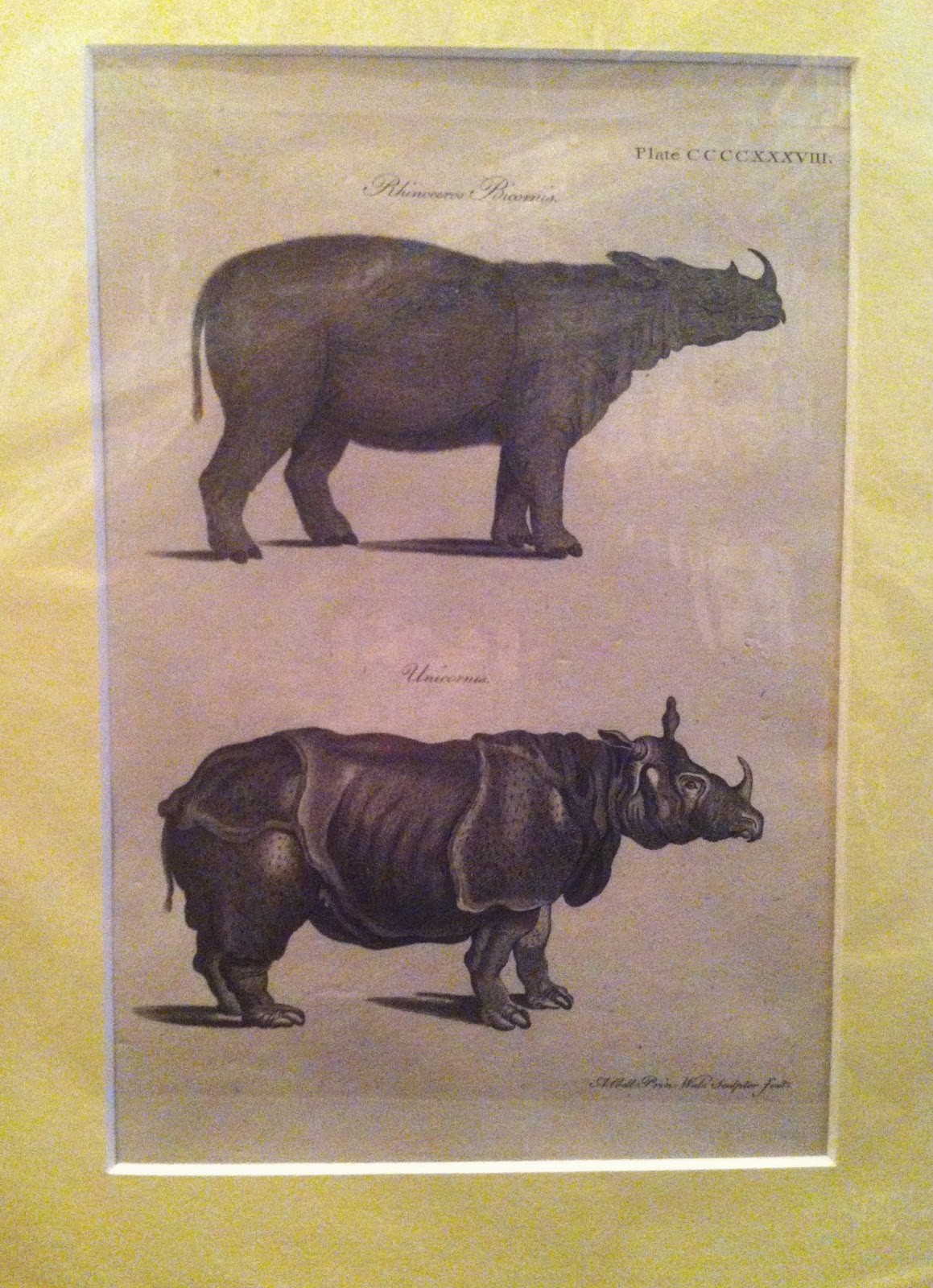
The second place we went was the Portobello Road Market. There were numerous stalls with all kinds of things from tourist crap to vintage jewelry and antique prints of human anatomy. I bought myself two old prints of animals, goats that are clearly up to no good and disturbing rhinos. They are still in the protecting plastic, I plan to find ominous black frames for them.


We were in London only four days so I did not get to see everything I wanted but these were the things I actually experienced and can recommend to goths. There was also an exhibition of witches and witchcraft in art in the British Museum but it too ended some time ago.

Thanks for reading and next time it is time for The Curious Professor Z's Monthly homework assignment and after that I'll post another Creepy Reads Review of a story by Neil Gaiman!

Thursday, 8 January 2015

DIY: goth-y reflectors (or safety first but fashion is second!)

I must have a fewer or something, this is a second DIY post in just a few weeks! This post is about making goth-y pedestrian safety reflectors, also known as reflectors or luminous badges.


Reflectors are not necessarily so important in cities with bright streetlamps and neon signs but they are very useful in suburbs, small towns and in the country, where might not be sidewalks nor streetlamps on every road. As they say, a reflector is a pretty cheap insurance against being hit by a car or other fast moving large object.

Reflectors are like bicycle helmets, at some point people'll think it's "uncool" to use one. Well, if the reflector is really nice and cute, it is no longer so uncool.

What you need:
- a felt cloth: the size of a normal A4 printing paper will probably do
- luminous/reflecting fabric
- some yarn
- a safety-pin or two, depending on how many reflectors you make
- some thin thread or a flat iron or both
- paper and pen if you want to make a template
- scissors or some other instrument to cut

I chose black felt (no surprise there) but of coarse there are many other options, like blood red or emerald green and so on. The reflecting fabric is the color it is, there were no options in my local store. I somehow doubt there are any options in general, the point of it is to reflect light.

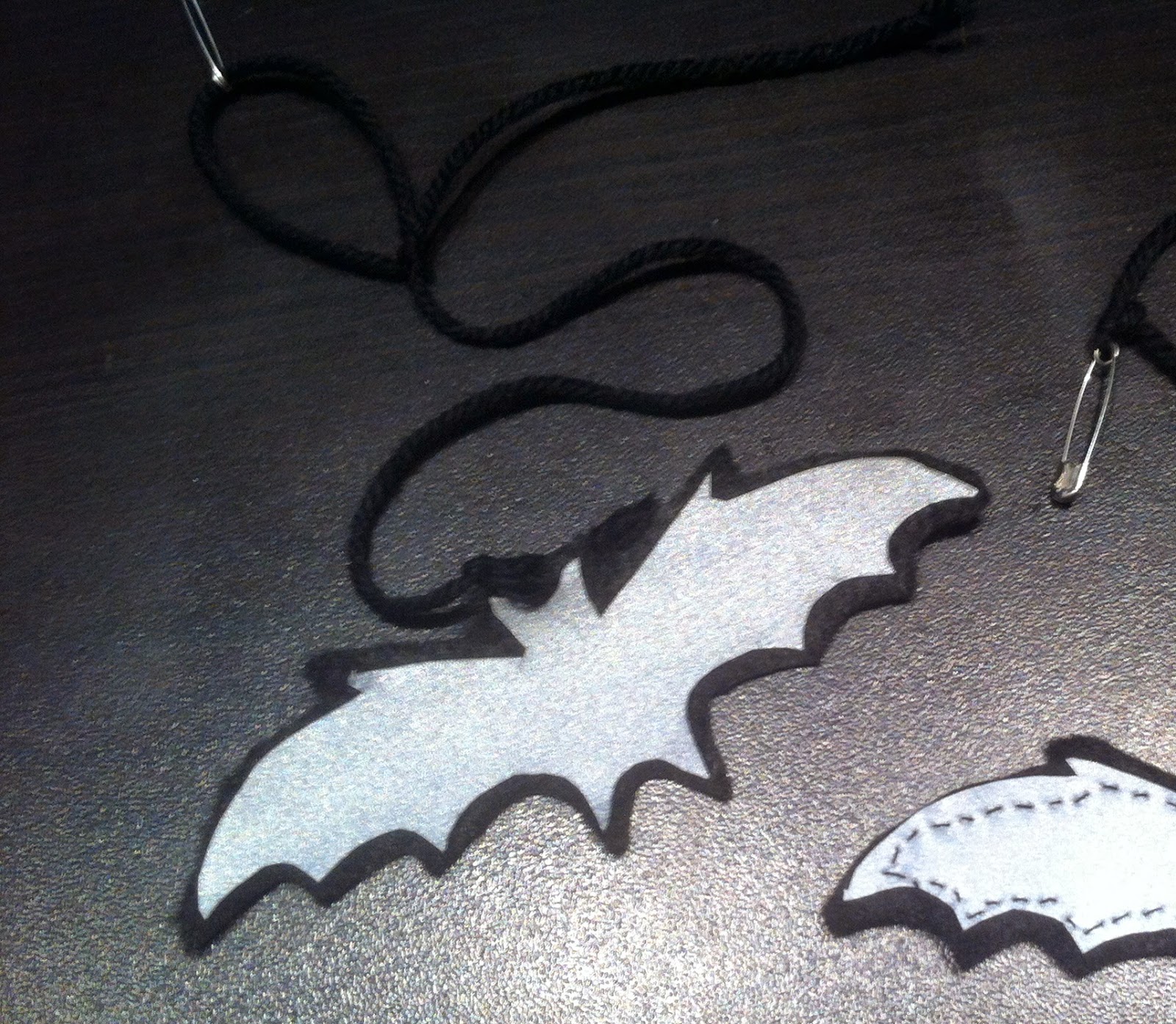
When making a reflector suitable for a goth, the shape of the reflector matters. A spider is an easy shape but more talented person could even make a scenery of a cemetery or a profile of E. A. Poe! Knowing my own limits, I chose to make two bat-shaped reflectors.

Since I wanted bat-shaped reflectors I first folded a normal paper to draw half of a bat and then cut it so that wings would be somewhat similar size. I must say I am quite pleased with the shape, even though the other ear is bigger than the other. I have no idea how but luckily it doesn't really matter.


After making a paper template I used it to draw on the back of the reflecting fabric. If you want a really useful reflector, you'll want the both sides to be luminous, so you'll need two identical (or not if you do not want the both sides to be alike) pieces of reflecting fabric.

Because I am not that crafty person I do not have all kinds of crafty tools so I used ordinary scissors to cut the felt and fabric. A carpet knife would be more precise, or one could even use some other cutters made into ornamental shapes (at least that is what they suggested in the tag of the reflecting fabric).


I did not bother to draw bats on the felt too, instead I cut out a piece that was big enough for the reflecting bats. I left some margin on the felt so that the black color would also be seen and so that the rims might protect the reflecting fabric and it would not wear from the edges. When the reflecting fabric is attached, one can cut the felt into the proper shape.


It is also smart to leave a little more edge to a small area so that you can pull the yarn through there. The point of the yarn is that you can attach the finished reflector to your clothes. Of coarse I managed to forget this while cutting the first one and I am now a bit worried the felt is not thick enough and is going to be ripped if the reflector is ever caught into something.

Some of those reflecting fabrics are equipped with a coat of glue, so that you can iron it to another fabric. Some also have a detachable film so one does not need a cloth between the reflector and the iron. After ironing the film is gently detached.


So, depending what kind of reflecting fabric you have, you might be able to attach it to the felt with heat. Reflectors are usually smaller than the face of a flat iron so try to hold the felt from a corner with another hand while ironing. Felt can have static electricity and get attached to the iron if you are not careful. Believe me, it is not pleasant to try to pick it off. Especially if you panic like I and do not use any tools instead of bare fingers...


I found a fabric that has glue surface on the other side but the salesperson suggested it might be a good idea to make a few stitches to make sure the fabric won't detach. That is why one needs the thin thread. As you can see from the photo below, my stitching skills are equal to the skills of a three-year-old. So, one out of two reflectors looks a bit crappy but luckily one can not see it from a distance.


If you use thread to attach, make sure the needle you are using is thin, so that it won't shatter the reflecting surface, if it is made of stiff material (plastic-like stuff). You also might want the thread to be more subtle color or perhaps fishing line, so it would not look like ugly stitches like on my poor bat. It looks a bit like Frankenstein's creature, so I'll just claim that was the point.


When the reflecting piece is made, one has to attach it to the clothes, so one needs the yarn and a safety-pin, as mentioned before. It's a good thing that a reflector can spin around freely, because then it can reflect light from various angles and that way it is more safe because it can reflect light the light of cars headlights in various distances and various directions.


Here you can see that I've attached one bat to the sleeve of my coat. The other bat is on the other side hanging from the hem of the coat.

Monday, 29 December 2014

Gothic Art in Spotlight: art and design out of old naval mines


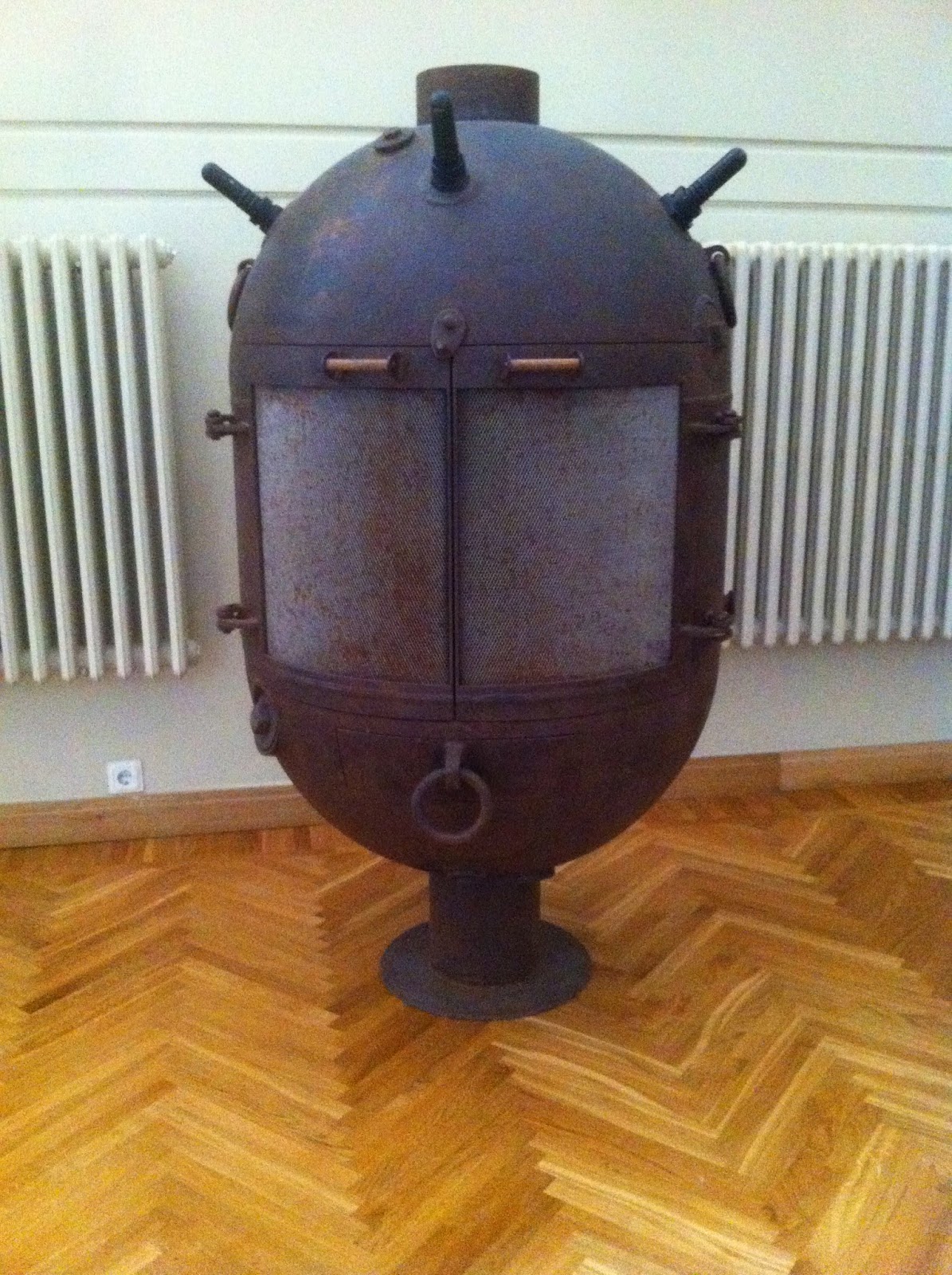
A bit before the Holidays I took a day trip to Tallinn, Estonia. There I visited art exhibitions by KUMU, the art museum of Estonia. Most of the exhibitions are of coarse in the building on KUMU but there was also a small exhibition presenting works of sculptor Mati Karmin at the old terminal of the Tallinn Airport. According to the webpage of KUMU, the exhibition is open till 5th of May 2015. So, if you happen to visit Tallinn before that, you have an excellent opportunity to see these works made out of old naval mines yourself! The place is right next to the Airport and less than a 20 minute bus trip from the center of Tallinn.


The baby carriage and an armchair
 I must admit I was a bit puzzled by the fact, that instead of being in the exhibition area, these two were just parked in a corridor. Maybe they were renovating the floor in the exhibition room, I don't know.
Close-up, look at the little toys for toddlers!
What is this about then? The project is about making objects of art and design out of old army equipment. The artist who started the whole project, Karmin, is a very notorious and distinguished Estonian artist, who has made many monumental sculptures since the eighties and the latest was finished 2012. He has had numerous solo exhibitions in Estonia, Hungary and Finland.

The armchair from the front.
I saw a fireplace, three chairs and the baby carriage. In their webpage you can see they make all kinds of other things too, for example a toilet, a grill oven, a coffee table, and a bathtub!

A fireplace, I presume.
I think these design objects are marvelous, they are fun but also constantly remind what the used material was actually for; destroying submarines and other vessels during war.

20's accessories in KUMU
This no longer is related to naval mines but I also saw an exhibition in KUMU of 20's fashion and art déco, I am sure some of you love vintage styles and might be interested of this exhibition. It is open till 18th of January.


Saturday, 20 December 2014

DIY Bookish Holiday Decorations

I saw a nice DIY idea for Christmas ornaments in a magazine and decided to try it. The ornaments are instantly more goth-y if one uses black ornaments, like I did, to begin with and chooses the right text.


I did not have the heart to start to shred a novella of Edgar Allan Poe or another dear horror story and I would not advise people to destroy their favorite books. Instead it is wiser to buy a pocket book from a flea market. Or use some disgusting novel one has received as a present. An instruction manual of some apparatus can be a fun choice too.

I bought this book and I chose it for two reasons. It costed 1 euro and even though it is not a goth-y novel, there are delicious sentences like "I think she is a Russian prostitute" and "He is a genuine psycho", which can be hilarious if other people start to examine my ornaments too closely.


What you need:
- old Christmas ornaments, preferably a dark color, no patterns or figures
- glue
- a book you are willing to rip into parts, or any printed text
- black glitter glue
- clear varnish


First clip or rip parts of a page. You do not have to try to get whole sentences or anything but it is nice is one can read a few words here and there.


Glue them on the ornaments in a formation that pleases your eye. Add black glitter glue, especially if you have goofed some part of the previous phase, for example the paper is wrinkled or the glue has smudged the edges. Black glitter is also added to places that you feel it fits.


If you like, in the end you can gently coat the ornaments with clear varnish. It might keep the paper on the ornaments better but the ink can start to run if you are not careful. Choosing the right kind of varnish is important.

I of coarse could not follow my own instructions because I forgot to make sure I actually had glue that had not mysteriously dried up. I used the varnish from a craft store as a substitute and it work quite well. Of coarse the coating became a bit "rough" but it does not bother me much.

When you have finished an ornament it is good to hang it somewhere so that the surface can dry up. I used one of those thingies that are usually used to dry laundry.


Happy Holidays to you all!

Sunday, 14 December 2014

Creepy Reads Review: John Polidori's Vampyre - The first vampire novel.

A tale of an aristocrat vampire 70 years before Bram Stoker's Dracula!

The topic of this post is a novella (or a short story) written by John Polidori, a man who attended the competition of horror writing among Lord Byron and Mary Godwin. She would later become famous as Mary Shelley, the writer of Frankenstein.

The edition of Vampyre* I own has a really good introduction by Christopher Frayling. He states that this story by Polidori was actually first told by Lord Byron in the competition. Byron and Polidori had a falling-out that summer of the competition and Polidori rewrote the story and published it three years later. The situation in 1819, the year of the publishing, was rather heated, there was an introduction attached that linked the vampire of the novella and the extravagant persona of lord Byron. It was also clear that the selling of the novella was influenced by gossips of the day. Here is the novella with those provoking attachments for free, by Project Gutenberg, if you are interested!

Side note: I actually read years ago another interesting short story, that fictionalized Byron and made him a vampire and John Polidori was his victim. It was an intriguing scenario but for the death of me I can't remember where I saw it, who had written it and what was the name!

I really like the Finnish edition of Vampyre by publishing house Faros, the cover is really elegant and gloomy. Here is a photo of the one I own, as you can see it is a bit worn out.


After that beauty of the cover, let's move on to the content of Polidori's novella. I think it is an exceptionally good example of the alive and kicking Romanticism among the era of science and advancement. The narration is almost scientific at points, reporting the story, but the actual events are spooky and supernatural, like in a typical Gothic or Romantic novel. (In this case I am referring to Gothic as a literature genre not a modern subculture.)

I love how the narrator is slightly ironic towards the hero of the story, a young gentleman called Aubrey. The narrator points out that poor Aubrey is a bit silly, believing into all kinds of superstition. Still, Aubrey is a decent bloke, almost too good to be true. He is appalled by vice and he is a real gentleman when it comes to the opposite sex and romantic feelings.

The story is mostly from Aubrey's point of view. That means the narrator concentrates on things Aubrey sees and thinks, instead of elaborating the inner worlds of other characters. Only in the end the thoughts of Lord Ruthven, a man Aubrey believes is a vampire, are revealed. It is quite entertaining, although I must admit all characters are rather plain archetypes. That is understandable, this being the first vampire novel(la).

J. W. Polidori. Source

I would say this horror story is also a tragedy (again as a genre), so the expectations of the reader are going to be rather grim, if they start to read the novella as a tragedy. I hope I am not spoiling too much but a tragedy usually ends in tears, the hero is destroyed by fate, everybody suffers and so on. People tend to love a good tragedy, that's why when you are asked to name the first play by Shakespeare that comes to mind, you usually say Macbeth or Hamlet. Polidori's Vampyre too is going to be a sinister ride for the reader, so I am sure many goths of today will like it!

The language is old, being from the 1819 but the novella is still rather fast to read. I do recommend it.

Thanks for reading and next time I shall post a bit before 24th, and tell a nice little way to DIY old Christmas decorations.


* The whole name of the published book was The Vampyre; A Tale but I'll refer to it as Vampyre.